V&A: Making East London Porcelain
About this record
Early Bow porcelain – a multi-disciplinary investigation into the creation of porcelain close to what is now the Olympic Park in Newham.
Why?
White porcelain, sometimes referred to as ‘white gold’, was very appealing and sought after in early modern Europe, but until the middle of the eighteenth century it could only be imported at great expense from East Asia.
Factories were created in London to crack the secret alchemy of making porcelain. This led to a flurry of experimentation, and to a number of tentative recipes in the 1740s. One of the first factories was Bow Porcelain Factory – located in what is now the London Borough of Newham – marked on John Rocque’s Map of London, 1761.

John Rocque’s Map of London, 1761.
In collaboration with the London Borough of Newham and Oxford’s Ashmolean Museum, V&A scientists and curators are investigating early Bow pieces to try and follow this trail of experimentation. Scientists are looking at the composition of early porcelain pieces, art historians are painstakingly puzzling out any hidden evidence in the archives, and makers are reproducing the processes that were trialled in eighteenth-century London. Together, we are combining art, science and history to explore how heritage science and re-making practices can help us better understand the places we live in today and inspire us to innovate and experiment tomorrow.
You can read more about our team here.
Historical summary
The remarkable production of decorative and utilitarian wares at Bow porcelain factory reminds us that London was a global centre for experimentation and creativity during the mid-eighteenth century. The first patent by Bow was submitted by two of its founders in 1744. However, most existing wares have usually been dated from after the second patent of 1749-50. Insurance policies show that by 1760, it was a large-scale operation, with 300 employees, the factory building being modelled on ‘that of Canton in China’. This influence extended to the business, which also advertised itself by the name of ‘New Canton’.
Situated just beyond Bow Bridge, with direct access to the River Lea, the waterway location aided shipment of raw materials from around the country – and even from further abroad. Bow imported Cherokee china clay known as Unaker from South Carolina in the American colonies. Other materials came from closer to home. The bone ash which was famously used by Bow most likely came from a local piggery.
Scientific investigations
Supported by funding from the AHRC, scientists from the Ashmolean Museum and the V&A are looking at the composition of Bow porcelain objects from the Newham Archives.

V&A Bow science objects
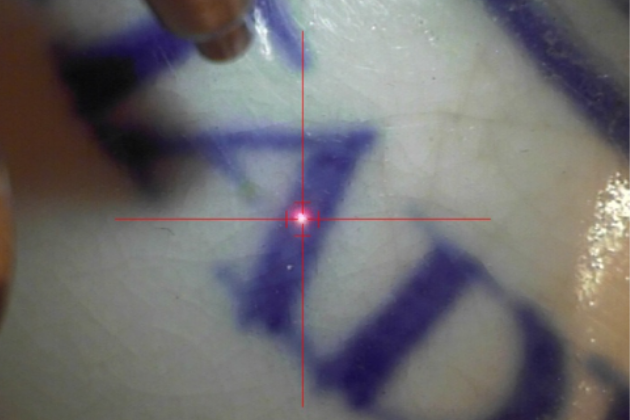
They are using non-destructive, non-invasive techniques to quantify the ingredients in the glaze and the body of the porcelain. Their scientific technique of choice is X-ray fluorescence (XRF), which provides information about the chemical elements present in the objects (is there lead? Is there calcium? Is there gold?).
With porcelain, XRF can help us to understand what materials have been used to make the body of the object (which type of clay, which additives), which elements have been added to provide an opaque glaze on the surface (usually lead or tin), and can also suggest what pigments have been used for coloured decorations. For example, in porcelain cobalt is usually associated with blue decorations and gold can be associated to purple or maroon decorations.
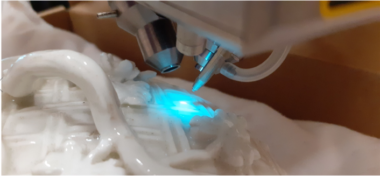
V&A sugar bowl analysis
Bow patents
Two patents were filed in 1744 and 1749, respectively, detailing the composition and procedure devised to make white porcelain. The project’s scientists are comparing their analysis results to these patents and have shown that the objects analysed so far are in agreement with the second Bow patent.
Analysis of the porcelain body
These are the results of the analysis of the body of the Bow pieces so far:
- Phosphatic composition (meaning bone ash was used)
- Correlation with 2nd Bow patent
- Traces of cobalt with associated nickel and arsenic may explain the ‘mushroom’ colour of some of the objects

XRF Spectra of Bow Porcelain Bodies
Analysis of the porcelain glaze
These are the results of the analysis of the glaze of the Bow pieces so far:
- High lead content (~50%) with 1-2% potash (K2O). No tin or cobalt
- Correlation with 2nd Bow patent
- Correlation with analyses of glazes from the Defoe/New Canton period c.1744-53

Re-Making recipes

Re-making recipes workshop
We have used a range of materials to re-create the Bow Porcelain recipes, interpreting the new scientific analysis alongside the eighteenth-century patents and testing them using both slip casting and press moulding techniques.
Alkaline Frit – ground glass
Ball Clay – very fine particle sized clay, named after the 30lbs ‘balls’ it was shaped into in Dorset for transportation, which is a ‘secondary clay’ formed into deposits from eroded granite rocks
Bone Ash – calcium phosphate derived from calcined animal bones
Flint – a natural silicon oxide, but not as pure as quartz
Flux – an oxide that lowers the melting point of a glaze and helps a clay body vitrify
Kaolin – clay high in alumina, named after kao ling – high mountains, it is a ‘primary clay’ washed from the rock face with water
Potash Feldspar – mineral derived from decomposed granite which is used as a flux
Quartz – a natural crystalline silicon oxide

Chobham Academy V&A workshop
Heylyn and Frye’s December 6th 1744 patent
The Patent described how: ‘at a considerable expence of time and money in trying experiments, [we have] applyed ourselves to find out a method for the improvement of the English earthenware, and had at last invented and brought to perfection “A NEW METHOD OF MANUFACTURING A CERTAIN MATERIAL, WHEREBY A WARE MIGHT BE MADE OF THE SAME NATURE OR KIND, AND EQUAL TO, IF NOT EXCEEDING IN GOODNESS AND BEAUTY, CHINA OR PORCELAIN WARE IMPORTED FROM ABROAD.”
‘…The material is an earth, the produce of the Chirokee nation in America, called by the natives unaker, the propertys of which are as follows, videlicet, to be very fixed, strongly resisting fire and menstrua (dissolution), is extreamly white, tenacious, and glittering with mica. The manner of manufacturing the said material is as follows:- Take unaker, and by washing seperate the sand and mica from it, which is of no use; take pott ash, fern ash, pearl ash, kelp, or any other vegetable lixiviall salt, one part of sands, flints, pebbles, or any other stones of the vitryfying kind; one other part of these two principles form a glass in the usual manner of making glass, which when formed reduce to an impalpable powder. Then mix to one part of this powder two parts of the washed unaker, let them be well worked together until intimately mixed for one sort of ware; but you may vary the proportions of the unaker and the glass’.
No objects are known from this period, so we couldn’t analyse them. This is the recipe we have created based on the information given in the patent:
40g Kaolin
10g Potash Feldspar
10g Quartz
Bow ‘New Canton’ porcelain, 1747
The second Bow patent dating to 1749 (Her Majesty’s Stationary Office 1865) describes the use of “virgin earth” as a flux, consisting of “all animal substances, all fossils of the calcareous kind, such as chalk, limestone…”, which is calcined, ground and mixed with sand or ground flint pebbles and fired to make a lime alkali glass. “Virgin earth” is widely interpreted as calcium phosphate deriving from calcined animal bones. The scientific analysis closely corresponds to this information. Here is the recipe we have created:
15g Ball Clay
15g Quartz
28g Bone Ash
2g High Alkaline Frit
(Optional: add 0.05g cobalt oxide to the mixture, giving it a ‘mushroom’ tone)
Chobham Academy

Chobham Academy Learning about London Porcelain in the Ceramics Galleries at the V&A
Ten sixth-form students studying arts and science subjects have been researching with us. They are curating their practical, scientific and historical findings in the exhibition ‘Making East London Porcelain’ at Stratford Library. They will showcase twelve artefacts from Bow Porcelain Factory, selected from the Newham Borough of London’s important collection. These objects have not been on display in the Newham for over 20 years!

Chobham Academy object handling Newham Bow porcelain pieces
You can visit their exhibition on the ground floor of Stratford Library any day between 1-30 June – just check the library opening times by following this link.
Acknowledgements
Making East London Porcelain is part of the larger project ‘Experimentation and Placemaking: connecting communities with the technological and innovation histories of London’s early porcelain Manufacturers’ with the V&A Museum, Ashmolean Museum and Newham Borough of London. This has been made possible by the Arts and Humanities Research Council’s (AHRC) Capability for Collections Fund and Newham Heritage Month. This project is led by Dr Lucia Burgio, Dr Caroline McCaffrey-Howarth, Dr Georgia Haseldine and Dr Kelly Domoney.

Join us for an object-handling workshop with local artists as we celebrate the launch of our exhibition Making East London Porcelain. FULL DETAILS +

Learn how to mix and sculpt your own historic porcelain inspired by Newham’s remarkable history of ceramic manufacture FULL DETAILS +

Once based in the vinicity of the QE Olympic Park, the Bow Porcelain Factory's history is explored in the Making East London Porcelain exhibition. FULL DETAILS +
Additional record details
- Type: Writing
- Date created: 2022
Heritage newsletter
We would like to send you monthly emails spotlighting heritage content in Newham, as well as updates and opportunities to be involved in next year's festival. Be the first to hear about new projects, funding opportunities and ways to be involved.