‘Hear My Voice’- Stories From The South Asian Diaspora: Naseem Begum
About this record
This record is about Naseem Begum’s personal connection to Newham’s Arts and Cultural Heritage.

Naseem Begum © Farzana Hakim
It was an absolute honour for me to interview my mum Naseem Begum as part of my project. She was the ideal participant I wanted to reach out and give a voice to. Her story was truly inspiring and again opened up my eyes to some of the struggles a woman emigrant of her time had to endure here. Before this interview, Naseem Begum had hardly ever spoken about her past yet many women from the South Asian diaspora of her generation will relate to her story and I am sure her experience will be a mirror for many others. For me, Mum’s story made me realise how different my life is to hers and how much I owe her for making me the strong, independent and empowered woman that I am today.
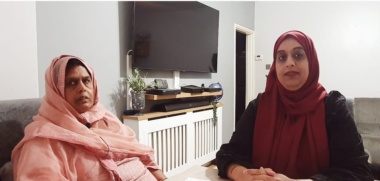
Interview with Naseem Begum © Farzana Hakim
Naseem Begum wanted to conduct her interview in Urdu, her mother tongue, therefore, respecting this wish, to make sure, all voices were heard, the interview was done in the Urdu language. I will be translating the oral history into English.
Naseem Begum married Abdul Hakim in the summer of 1975. The groom had travelled all the way from East Ham in London for the wedding. She was excited yet nervous about the prospect of moving to the UK. Naseem knew nothing of the UK. As a young woman of 18 years, she had never travelled outside her home city of Gujar Khan.
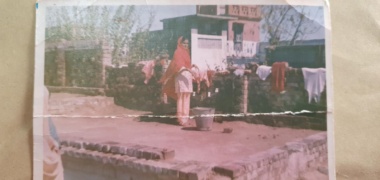
Naseem Begum in Pakistan before she was married © Farzana Hakim
Within a year of her marriage her visa came through and with her newborn son, Abdul Jabbar Hakim, she said goodbye to her family and set off for a new life in Newham.
For her, with no skills in English and no friends here, settling in Newham was hard for her.
I cried the whole time. It was cold and lonely here. I missed my mum and I missed my brothers and their children very much. There was nothing to do here for me. I only cried all day, urging my mother-in-law and father-in-law and husband to send me back. I didn’t like London at all.
Naseem Begum told me, keeping busy helped her settle in her new life, albeit slowly. In 1978, she gave birth to me her second child and in 1980, she had her third child. The school runs and daily chores became her routine.
Naseem Begum, spoke at length about her most loved sewing machine which her husband bought for her in 1979. This cost him £300 in those days. It was a costly investment for a brand-new sewing machine, but for her it was worth the money because this machine would give her a small sense of empowerment and the means to earn her own money.
She began going to a factory on Katherine Road to learn to stitch clothes. In the late 70’s and the 80’s many women of the South Asian diaspora were sewing clothes either in factories or in their homes throughout Newham for the textile and fashion industries. Men from factories would drop off bundles of cut fabrics and dresses which women like Naseem Begum would sew in their homes. On an average day, Naseem Begum could sew as many as fifty dresses, blouses, trousers or skirts in her home. The factory representative would come to collect the sewn bundles a few days later and she would be paid on a weekly basis. Naseem Begum used to work from home for many years. She stopped working in the early 90’s as her knees had started to hurt.
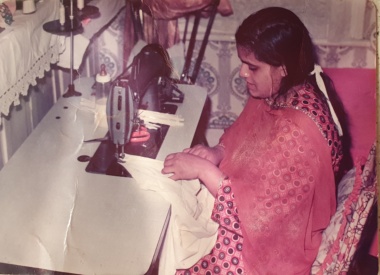
Naseem Begum at work on the sewing machine © Farzana Hakim
Naseem Begum’s machine has been her trusty companion for many years. She still has it and uses it on occasion to stitch colourful shalwar Kameez outfits for herself and her granddaughters.
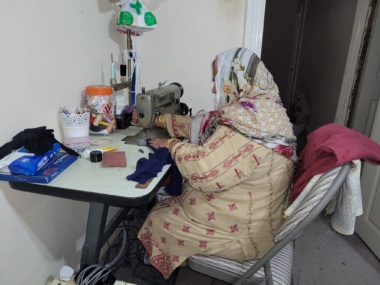
Naseem Begum today with her trusted sewing machine © Farzana Hakim
When asked about entertainment, Naseem Begum recalled fond trips to the cinema with her husband on Sundays to watch Indian films.
We would leave the children at home with the grandparents and spend a nice time outside. We’d watch a good Indian movie and then eat from outside. We’d eat at a halal restaurant. Mainly just rice dishes or chicken was available then…
We’ve already learnt from her husband Abdul Hakim’s story that their household was one of the first to buy a colour television and VCR Player in their small close-knit community. About this, Naseem Begum said,
People used to come to our house and not get up until they had watched 2 or 3 films. I used to get tired making tea after tea and food for them all.
When I asked whether they helped her?
She laughed and replied, “No, they just watched the movies.”
Despite this, Naseem Begum, appreciated the little joys. She enjoyed going to her relatives’ houses and would look forward to birthdays and parties at each other’s houses. She made new friends over the years and settled in her life in Newham.
About her life today, she said,
“Newham has always been my home and I don’t think I will ever move out from my home. All my children are grown up and live nearby. I spend my days with my grandchildren now and am happy with how life turned out.”
Additional record details
- Contributor: Farzana Hakim
Heritage newsletter
We would like to send you monthly emails spotlighting heritage content in Newham, as well as updates and opportunities to be involved in next year's festival. Be the first to hear about new projects, funding opportunities and ways to be involved.