The Call Outs: Shadows of the Olympics
About this record
The London 2012 Olympics had a major impact on the housing situation in Newham – both positive and negative. So how have things changed? The Shadows of the Olympics is a play about community, about characters, about making your voice heard and about cleaning up dirty soil. Set in a pub near the Clays Lane Estate, characters from before, during and after the Olympics share their experiences of how their lives changed.
We are a small theatre company that formed in 2020 at the University of East London. The focus of our work is political and socially orientated and we are very passionate about calling out injustices. Our project is a theatre performance about the effect on housing due to the 2012 Olympics, specifically the demolition of the Clays Lane Estate.

Authenticity is very important to our work and we therefore were looking for residents of Newham who maybe were impacted by the Olympics. We were interested in hearing people’s stories, both positive and negative, linked to the Olympics. We really wanted to know what people experienced during this time and since. This is at the heart of our performance.
Building on history
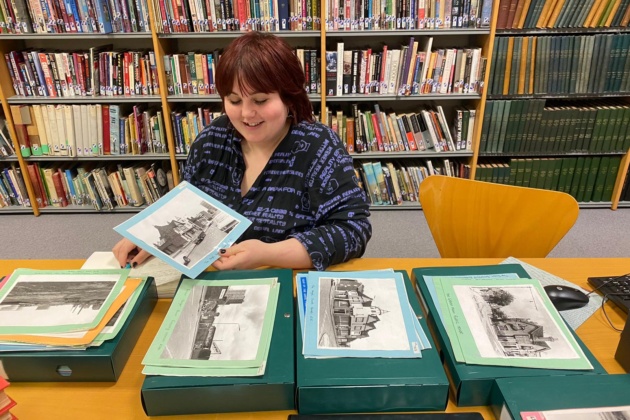
We had the opportunity to look through the photograph collection at the Stratford Archives, which showed the area of the now Olympic park, showing the old industrial sites, communities living around Clays Lane and street markets. We also found amazing magazine articles, which influenced our work and idea finding considerably. We read people’s views and opinions, the letters to the editor, and it all made us think about how people felt about the Olympics in Stratford.
“But she said especially in Newham the Games will be judged by what they leave behind and if they kickstart sustained regeneration and renewal.” Granger, C. (ed.). “MP’s impassioned Olympics plea over locals 2012 rights”. Newham Recorder, 11 May 2011, page 11.
We felt that this quote really spoke to us as we know in hindsight that the Clays Lane residents lost their homes for the Olympic Games. But was this the legacy? The loss of a community? The capitalist gain of many new swish apartments? The regeneration of an area that was not as desirable perhaps as it should fit a modern London?
We needed to find out more and were pointed in the direction of the Bishopsgate Institute near Liverpool Street.
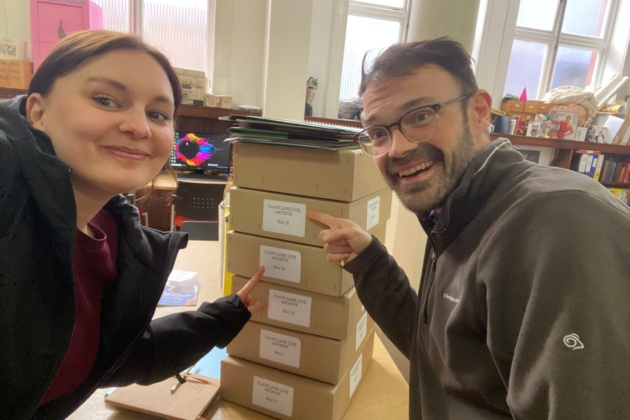
During this visit, we went through six boxes of documents, photos and other resources, even a theatre play script that was written by a former resident about his life at Clays Lane. We spent a few hours at the Bishopsgate Institute and were really happy with what we learnt. Most importantly for Soeren, there was the Inspector’s Report, which concluded that “the overt sense of community and the value that many residents put on their homes and their surroundings is foremost in my mind. Their loss will be a substantial one.”
Reflecting on the Past
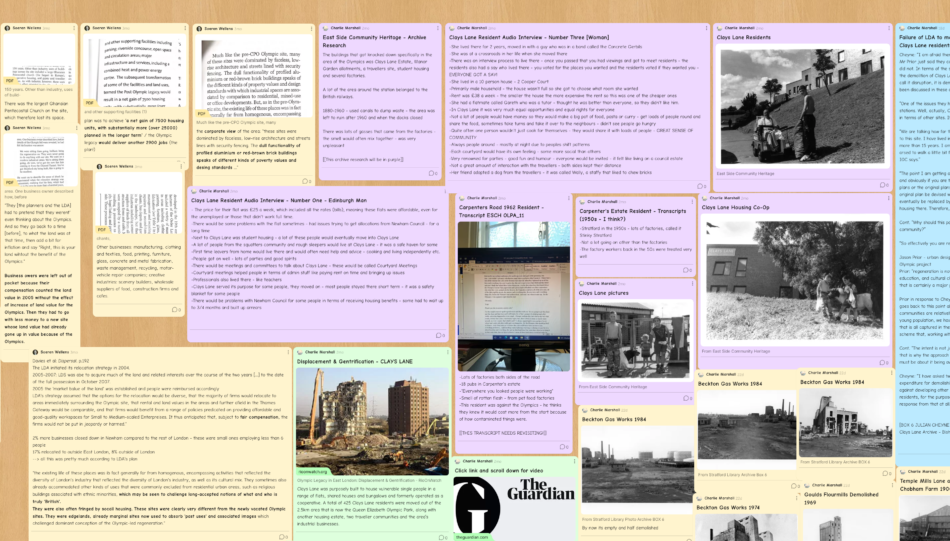
After our multiple archive visits we gave ourselves time to reflect on the research we had discovered about the Clays Lane Estate. With every single piece of information we found out, we then uploaded it to padlet – a collaborative online notepad. We each spoke at length about which parts of the research connected with us and what pieces we wished to include in our piece. For Charlie in particular it was an audio interview at the Eastside Community Heritage archive, in which a former Clays Lane resident spoke about her dog Wally, who used to chew bricks.
Turning facts into fiction
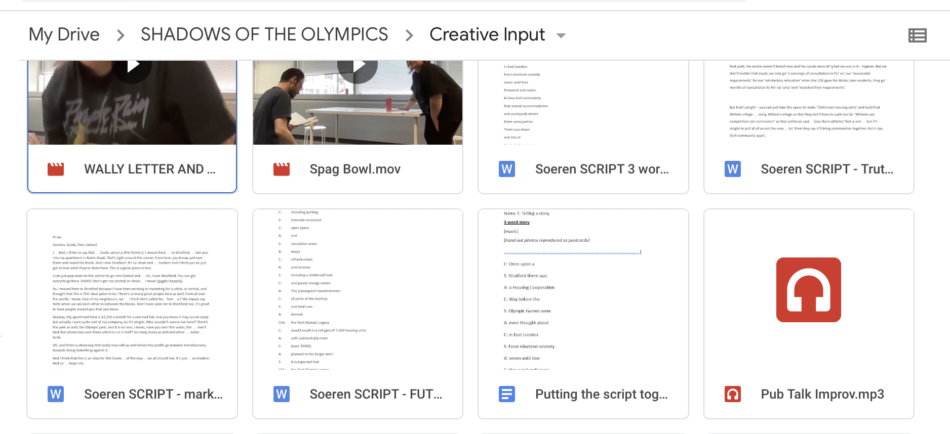
After weeks of fact finding at the Newham Archives, Bishopsgate Institute and Eastside Community Heritage,, we finally have begun to use what we have learnt to create characters, situations and moments for our performance. In true documentary theatre style, we are using facts to not only inform our play but also to quote within scenes. Exploring these in creative writing tasks has been very useful and allowed us to create a broad range of text types to use in our performance.
One example is Charlie’s Spag Bowl recipe, which makes reference to the tightly knit and open community that many residents enjoyed at the Clays Lane Housing Coop.
Did you know that Clays Lane was an entire housing estate that was demolished for the Olympic Site? Over 400 residents had to move…
“So effectively you are removing the Legacy from the people who live there.” Cheyne, J. “Failure of LDA to meet its own requirements to access disruption to Clays Lane residents”, Bishopsgate Institute: Clays Lane Archive. 2006
During our archive visits we were able to see the protest from the Clays Lane residents against the LDA (London Development Agency) concerning the demolition of the estate. Julian Cheyne, a resident of Clays Lane for over 10 years, fought against the agency and attended meetings to voice his opinion on the matter. We were deeply inspired by Julian’s determination to defend his community and we had the wonderful opportunity to have a chat with him about his experience on the estate. He told us about the facilities that the co-op had and the democratic nature in which it was run. He also told us about his pet cat Odie that lived until 23 years old – which naturally we were all the more inspired by.
We also were able to speak to Dexter Hanoomansingh, who lived at Clays Lane for a long time. He was able to tell us what it was like for him to live on the estate. Interestingly, he mentioned the strong community that prevailed during the time he lived there – the shared flats, the shared food. We learnt from him that mostly single students lived on the estate to start with. Of course, that meant there were lots of parties, and lots of fun and great friendships were made that have lasted until now. He mentioned what was most memorable for him: the warmth that existed in the place – both because of the central heating and because of the immense support people gave one another.

All The World’s a Stage
At the end of April, we have the chance to practically explore the creative writing work in a studio space. We will improvise around the ‘script’ that we have to date and keep developing our work, creating transitions and developing further scenes to include, based on research but also based on what we feel is needed to comprehensively show the impact of the Olympic Games on housing in Newham.
The Call Out’s play about housing and social issues during the London 2012 Olympics is running from 17-19th June. You can find out more and book tickets here.
Additional record details
- Contributor: The Call Outs
- Date created: 9th March 2022
- Location: Newham
Heritage newsletter
We would like to send you monthly emails spotlighting heritage content in Newham, as well as updates and opportunities to be involved in next year's festival. Be the first to hear about new projects, funding opportunities and ways to be involved.