Muslim artists in Newham
About this record
Two Newham-based Muslim artists discuss their creativity and the challenges of being outsiders in the Art sector.
Muslim artists in Newham
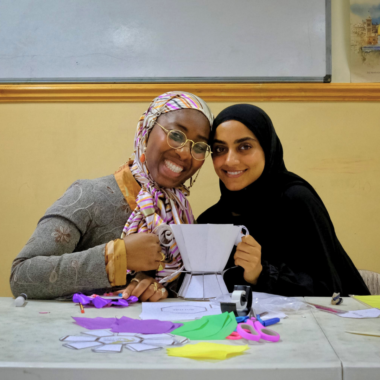
Memunatu Barrie (left) and Maryam Adam (right) at Newham Heritage Month 2022 ©Keith Martin
Memunatu Barrie and Maryam Adam are two Muslim artists based in London. They both grew up pursuing their creative passions and can now proudly call themselves amongst the few Muslim artists around.
Memunatu works as a textile designer, working with fabric to create designs for clothes as well as furniture.
She has worked on many different projects in the past among which includes the project she made in 2021 ‘Warm Citrus Skins’ which is shown in the images below.
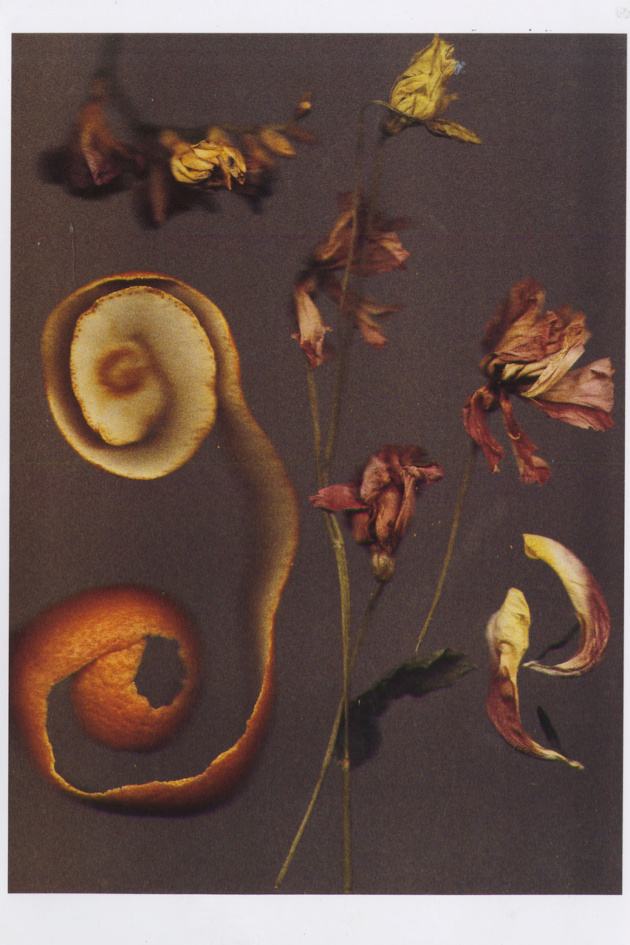
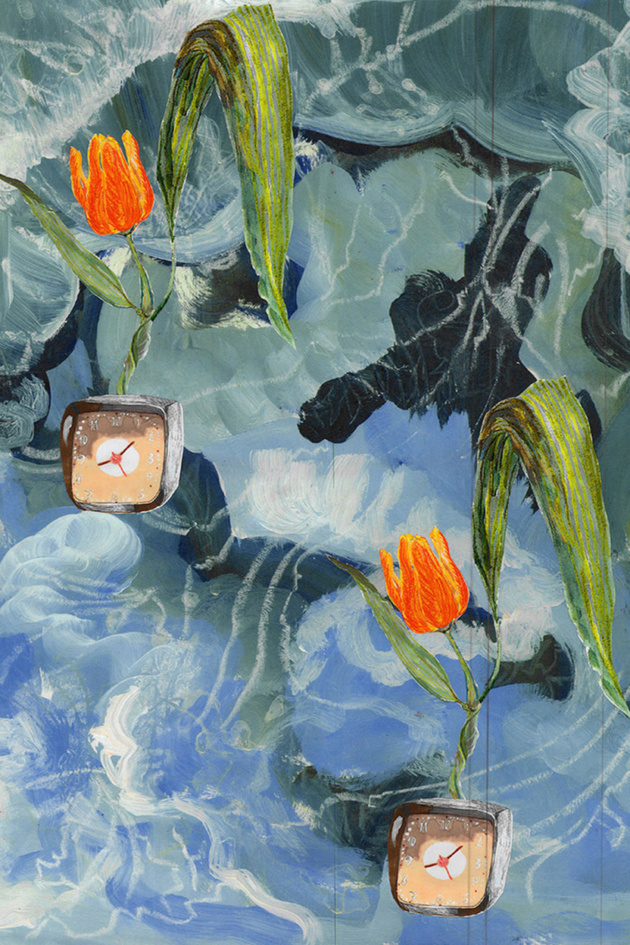
Memunatu describes in more detail what her work entails and what inspired her to work in this field in the audio clip below.
Maryam is a graphic designer merging various creative software with artistic techniques to create a wide array of products including animations, posters and websites.
Poster designed by Maryam for Newham Heritage Month 2023 ©Maryam Adam
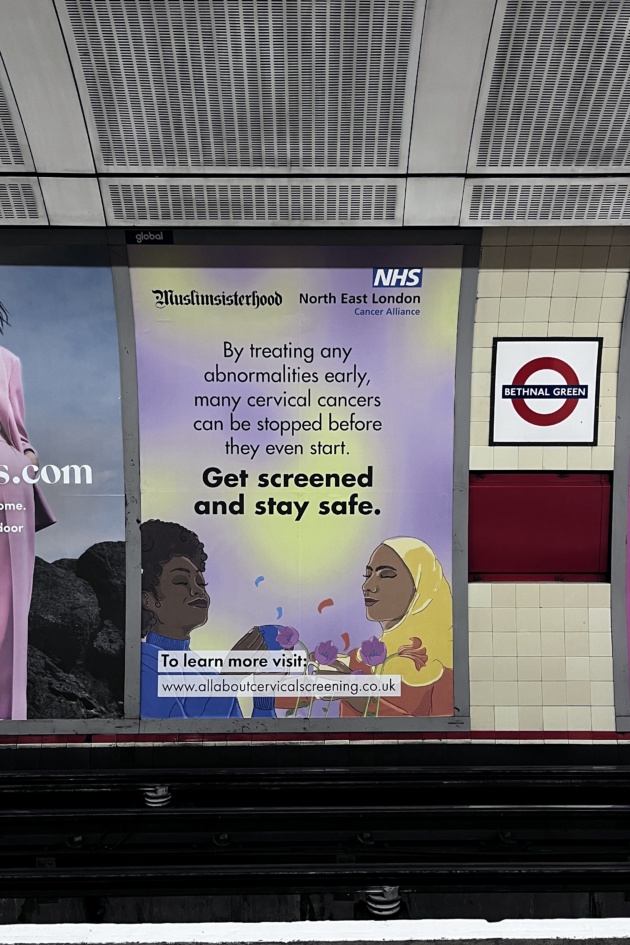
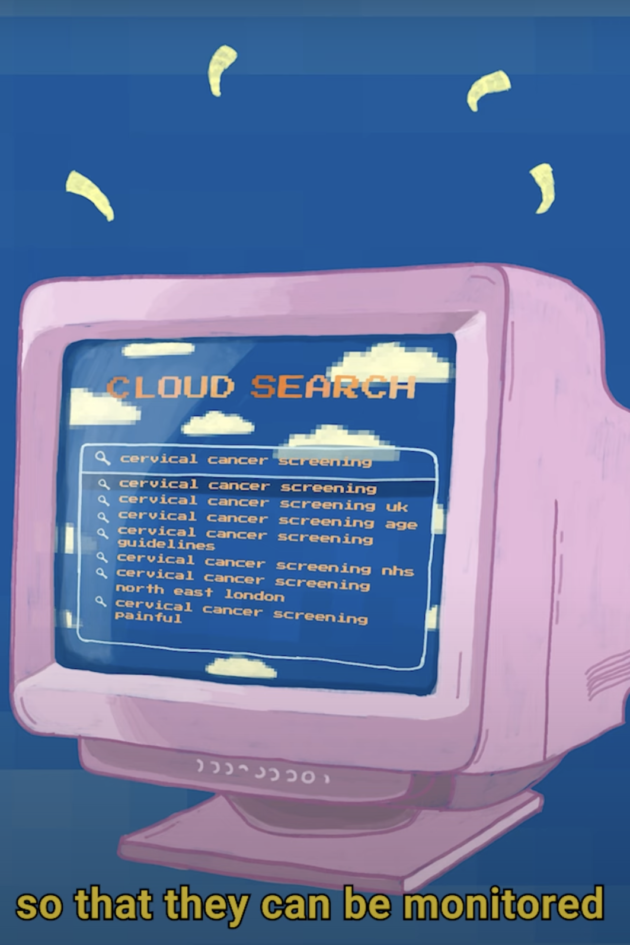
Maryam also worked with the NHS last year to help spread the very important reminder about cervical screening.
Cervical screening can help save approximately 4,500 lives a year and Maryam played her role by designing posters and animations to help spread awareness.
Her posters were even displayed in underground tube stations and the animations she designed were featured on NHS websites and YouTube as well.
The animation and other works that Maryam produced for this project can be seen here.
Being amongst the few Muslims in the art industry, Maryam and Memunatu shared what their experience has been like and what obstacles they have had to overcome to progress in this field.
In the audioclip below they discuss what stereotypes are associated with Islam when it comes to being an artist and how it’s difficult to network in an industry where you’re seen as an outsider.
Being Muslims, the artwork of Maryam and Memunatu is influenced by their beliefs and they talked to us about how everything is Allah (swt) creation which means everything that acts as inspiration for them is due to Allah (swt). They further explained what the importance of Islam was in their creative process:
Islam is obviously a big part of my life and kind of my day-to-day practice and the things I’m exposed to. So I think through concepts, Islam’s kind of applied to my work a lot, even in terms of who the art goes to, I think in running kind of workshops as well, kind of working with communities, in that way it’s linked to Islam.
Advising aspiring artists, the pair say that it’s really important to keep an open mind and be confident when producing your work. They emphasised the importance of talking to people who are already a part of the industry and to learn from their experiences.
Maryam and Memunatu previously worked with Newham Heritage Month when they ran an arts workshop last year, which is a fond memory for them as well as the participants involved. On the workshop they ran last year they said:
I feel like I’ve had lots of really amazing opportunities. But I think my fondest memory as an artist was actually in this mosque last year (for Newham Heritage Month), was it last year? When we ran the workshop with all the little kids. It felt really wholesome and like and, yeah, it just feels good to connect with the community.
Maryam and Memunatu have interesting projects in the works such as a new textiles brand for Memunatu, while Maryam plans on illustrating an original recipe book. They will also be joining us this year during Newham Heritage Month to run another workshop where participants will be able to learn more about Islamic art and traditional Islamic art forms.
To listen to the full interview with Memunatu Barrie and Maryam Adam, click below:
Memunatu Barrie and Maryam Adam full interviewOPEN
Interviewee: Maryam Adam and Memunatu Barrie
Interview Date: 6th April 2023
Interviewer: Syed Muaaz Asim
Transcriber note:
Q: Good afternoon. Today is the 6th of April 2023. My name is Syed Muaaz Asim, and we are here at UKIM Masjid Ibrahim. I’m joined by Memunatu Barrie and Maryam Adam who are two artists. Could you please introduce yourself?
A1: Hi, I’m Memunatu Barrie, I’m a twenty-four-year-old textile based in East London. I spent most of my childhood here and I’m currently freelancing.
A2: My name’s Maryam Adam. I’m also based in East London, also twenty-four. But I do graphic design/illustration and I’m generally an artist as well. And yeah, I’ve been creative all my life, studied art [all my life 0:00:49] as well.
Q: Thank you very much. Can you tell us about your background and how you got started as an artist, what inspired you, what led you down this route?
A1: So for me similar to what Maryam just said. I’ve been creating or being creative my entire life, as long as I can remember. Like I’ve always been really drawn to drawing, arts and crafts. In school that was my favourite subject. And then I guess I just progressed with it, like on to A levels and then I did a foundation year in arts and design. Then did a degree, Masters in business management because, you know, I flick. And yeah, so I’ve been doing arts all my life and I’ve just progressed in quite a linear kind of way.
A2: Could you repeat the question?
Q: So how you got into art, why art specifically, anything that inspired you, what led you down this route?
A2: Yeah, I think – I think similar to Mim, it was quite linear. But also I feel like it came quite naturally to me, it was always something I’d been drawn to as well. But in terms of like studying it or even working, being a working artist, when I was younger it wasn’t really what I thought would be the option, but it was the option. And yeah, pretty much, yeah, in terms of what inspired me, just I think like I said it just came really naturally to me. Like I just feel like I’m always like working with my hands and stuff like that. And yeah, in terms of skill and stuff we just progressed naturally as well so yeah.
Q: So I think Memunatu you said you’re a textile designer and you’re a graphic designer Maryam. So, what sort of led you to that field and could you explain a bit more about what textile design is?
A1: Yeah, so textile design is basically working with fabrics, so we have three pathways. We have knitted textile designers, who weave – weavers and then we have print designers. I’m a print designer and it basically is me creating or drawing let’s say florals or other kind of motifs, creating a design, surface design that will then be placed onto clothes but also furnishings. And it’s just a lot of drawing concepts, and my progression to textiles specifically stemmed from my love of fabric. I’m from a Sierra Leone background and as West Africans I think textiles is really important. Like when you look at the techniques and the methods of textile kind of creation but also around family time and kind of ceremony. Like for weddings we have a specific kind of wedding material that everyone in the family wears. And then my mum’s also very good at like interior design. So I feel like those kind of textile influences around me growing up really drove me to arts and design but specifically textiles.
Q: And Maryam, as a graphic designer what sort of drove you to that route?
A2: Yeah, so I mostly studied fine art and like painting and illustrating by hand. But then I felt like I needed something that was a bit more, like, I could monetise off of a little bit better. Because although fine art was a bit more of a passion of mine, I felt like I could make more money in the graphic design industry. And so the subject I studied was graphic communication design, so it wasn’t very like technical, it was more like, you know, there was a lot of like narrative and voice involved which was like very much up my street. Which is like storytelling and like illustration and things like that, so you can like work with brands, you can work on campaigns. Like I recently did like an animation for the NHS. So it’s pretty much like where people want you and I think there’s a really big market. So it does take a little bit of the love out of it when you monetise off of it but it’s still really rewarding.
Q: And I would I be correct to assume that graphic design is – because I’m someone who has no interest in art quite frankly [laughs], but it’s got to do with designing on computers and using software and stuff.
A2: Yeah exactly, that’s the main difference.
Q: So, as someone who’s terrible at art, what inspires you, what’s your creative process? Because I assume that’s the key thing, what inspires you, how do you sit down and think, okay I have to do this, what sort of goes on?
A1: So I think there’s inspiration all around us. I think it also depends on the purpose of your creation or let’s say maybe your interpretation of the creation. So if we were working on a commission you’d receive a brief from the company and they’d say, we want such and such product, such and such ad for whatever purpose. And then when I’m creating for myself the interest really varies. For my final major project for uni, it came during Ramadan, and I just felt like if I’m spending so much time on my kind of degree and my final project, which it takes up a lot of your time, it’s really time consuming. Then I want to focus on something which is also going to link to Islam in a way. And I think everything does because we live in this world and Islam is our way of life. But I focus on kind of concepts of spirituality and, like, the soul and the different kind of gaps between the physical body and the soul. So we had projects – I had a project which was very spiritual but then also other times it’s just like flowers. So it kind of can be very conceptual but other times it’s a little more practical, for commission for example.
A2: Can you repeat the question sorry?
Q: For your creative process, what inspires you, how do you sit down and think that I have to get this done, what ’sort of thought process; how do you reach that conclusion? Because for me that’s something – I don’t think I could do that. If I spent days doing that I don’t think I could come up with a decent idea.
A2: You know, I think it’s difficult for us to come up with ideas sometimes as well. Especially when you go to places like uni and they kind of like make you churn out ideas like really quickly and really often. And a lot of the time the creative process it isn’t like that, it does take some time and certain things come really quickly and certain things don’t. But in terms of what inspires me, when it comes to like a brief I can really sit down and work with like what I have because there’s some direction there. And then when I’m coming up with something of my own it’s usually quite easy because it’s quite free. I usually focus on things like social politics. My last project was about, like self-made project, was about like sort of dismantling what design is and – yeah, so yeah. And same Memunatu said, which is like all around me, storytelling, people, things like that.
Q: So, most people, for art it ends as a hobby – starts as a hobby ends as a hobby, you lot being professional, what’s it like? What’s different, what’s the same, is it better, is it worse? What would you say?
A1: So I think going back to what Maryam said at the beginning, that the difference maybe between it being a hobby and it being work is that sometimes the love does leave. Not necessarily us as individuals completely but working on specific projects sometimes. Like, if it’s not a hobby you’re not necessarily going to have fun. And sometimes, because work can be very unstable as a freelancer, a project will come along and you’re not necessarily super passionate about it. But you’ll take it because you need to pay your bills and you need the money. So that’s the difference between the hobby and the art. But then for me, personally, I feel like it didn’t just stop as a hobby because it’s something which makes me really happy to do. It’s something which I’m really confident in, like I think most of my skillsets do lie in being creative. Whether that is through storytelling or kind of interpreting things and building stories with them, or a practical kind of technical skillset. So I sew as well, and I know that all of those skills are monetizable. So if I’m going to do a job for the rest of my life, or for as long as I live, then I want it to be something which I enjoy. Because we spend a lot of time at work and I don’t want to be miserable at my work, at my job, which is a privilege Alhamdulilah, but yeah.
[0:10:00]
Q: Has the experience been the same for you or …
A2: Yeah, I would say pretty similar. I think, similar to Memunatu, like the reason why it came to a point where I was going to do something like very different from art and it wasn’t something I was interested in. But I thought there was no career in the art and design industry. But I think it’s kind of like how – obviously it doesn’t take a higher level to Islam because I don’t think any hobby or passion should but it’s kind of like how we live and how we breathe. It’s like who we are so it’s hard to like – it’s hard to not – hard to not like, yeah, be an artist. And I think the same with Memunatu, like the joyful aspect is like really important and I think there will come a time where it will be, like, easier where we’re happy throughout the process and we’re making money, but right now it’s a little bit like, yeah, slightly unstable. But I think it’s with anything at the beginning.
A1: And just adding to Maryam’s point about this is how we live and breathe. Like obviously not actually in the greater sense but in a way, yes, I think we are visual learners. And that’s not just within education in an institutionalised sense but also just the world and life – world view sense. So yeah, as visual learners I guess this is just our way.
Q: So, art being a demanding field, do you ever feel like you’re burned out or you’re lacking motivation? And if you do, what sort of techniques or tricks do you have to overcome that, get back in the groove?
A1: Yes, I think as an artist, designer, you will feel burned out a lot of the time. One of the reasons you’ll feel burned out is because you’re expected to kind of churn out work, even when you’re not naturally inspired. I think the best projects are projects where you’re naturally inspired and where projects – where a lot inspires you basically, when a project comes to you. But sometimes, because we need to make money, things don’t happen in that way so it can become very stressful, like the pressure, external pressure to produce even if it’s not coming naturally. And I also think as freelancers there’s periods where we have lots of work, so obviously we’re spending a lot of time just working, and then periods where there’s nothing. And it feels like even though you should say, “I’m sorry I don’t have the capacity for it,” that you can’t say that because you need to make the money for the months you don’t have money and jobs.
A2: Yeah, I agree. I feel like burnout, yeah, it’s so common in creative industries. And I think it’s common in any industry but especially in the creative industry. And I think going back to what we said before, like about, like, it’s the way we live and breathe, I think that’s why we get burned out so easily. And a lot of the time when I do big projects like I like – over a month break, like depending on how big it is. But yeah, so but then that, like it’s hard because like Memanatu said, like in terms of making money and things like that. I think in terms of what you can do to like kind of not have the burnout so often is like learning how to say no, which is what Memanatu touched upon. Learning how to say no, also like taking regular breaks. Like, I think people say that all the time but, like, even while you’re creating, just taking an hour break after an hour’s work or something or just having like – going for a walk or something like that. Just to, like, look at the project or whatever you’re doing from like an outsider perspective, because sometimes you’re so deep in it you can’t even really see the details. So I think taking regular breaks and knowing that you’re like owed that. And although we work twenty-four hours sometimes, not in like a – but, you know, like sometimes we’ll just work until like crazy hours just because we’re trying to get a project done, I think making sure you have like the weekends off like a normal sort of job, it helps.
Q: Now moving on to being a Muslim artist, how has – because often it’s being – it’s misinterpreted and how has being a Muslim affected you as artists? How has your faith affected you? Has it had any negative, positive experience?
A1: So, being a Muslim artist I think this questions really interesting, because though I understand the question from one angle, it’s also – it feels strange that we have to be … like I’m Muslim, number one. So everything else kind of falls under that kind of category and I don’t think Islam is restrictive when it comes to art. Of course, we have certain boundaries which we would follow in all aspects of our life. And I think in terms of practicality that there are sometimes like, oh I can’t do that because this goes against what Islam teaches us. But then I also feel like it’s not that hard if you are – you respect those boundaries. I think that perhaps for me the biggest kind of challenge has been networking. Because a lot of the time in the art culture, like when you go to, for example, private viewings, which is like the night before a show opens up to the public, there’s a lot of like culture around drinks. And then it’s like just generally networking, you know, the whole no handshaking thing [laughs], it can get really awkward at times. And I think a lot of the people in the space aren’t Muslim themselves or used to interacting with Muslims because when you’re working in the arts you’re working with a lot of people from kind of more privileged backgrounds where they could afford to do art. And also it’s an industry with lots of nepotism involved. So I think networking has been kind of difficult but I do think over the years it’s gotten a lot more inclusive and diverse to where you are meeting far more Muslim creators or people who kind of understand Muslims and respect certain boundaries. But yeah, I don’t think there’s much kind of hardship around being an artist and being a Muslim, as long as you are respecting the boundaries that Islam sets and not the other way round.
A2: Yeah, I think I agree with a lot of what Memunatu said. I think in terms of hardships I think also being around people who are from that industry, it’s like a specific group of people who have also like Memunatu said only been – not been around Muslims as much. So it’s not just that they don’t – they, you know, the drinks and things like that, it’s also like sometimes all they see is like your hijab or like – and they don’t see you as like human sometimes. Not to like take it to an extreme but sometimes the way they talk to you is a little bit different so it’s hard to kind of deal with that on a daily basis in the industry. But I think we’re also very lucky because, like, coming up I think we had a lot of, like, a lot of Muslim community I feel now have established themselves in the art industry. And so – and we’ve kind of come up with it so there’s like teams of people that we know around us and that’s really helpful. But yeah, it’s mainly just the normal hardships that comes with living in a western country and being a Muslim, and within any industry, it’s just different variables, but still, yeah.
A1: Also, just to add I think something which we were talking about earlier amongst ourselves that we forgot to mention, is that sometimes I guess a barrier can be – sometimes basically Islam, because of what we believe in, we can’t take every job that comes to us. So there is a conflict of interest sometimes but then obviously we’re like, sorry we can’t do that. Like we’ve had some people reach out to us for commissions. I had someone reach out to me once for a commission to design a poster. When I asked where it was going, they said pub, I said I can’t do that [laughs], I’m sorry. And I think Maryam’s had similar experiences.
A2: Yeah, like even stuff that you’re like, oh I would like – in a different world I would do this, like there was this one like painting for a really famous rapper for his album. And – but then I just felt like everything it wouldn’t make sense for me to do it. Yeah – but I think when you give up something like that I think better things …
A1: Allah replaces it with something better.
A2: Exactly, exactly.
A1: And the guilt would just be too much.
A2: Yeah 100%.
Q: So you mentioned that you’ve had – you have a circle of other fellow Muslim artists. How would you say the representation is, would you say there’s a decent amount of people in the field or – and have you worked with other people, have you collaborated with them, how’s that part of the experiences gone?
A1: So although I said that there is greater diversity, I think there needs to be a lot more work done. We have lots of peers who are working with creative artists but something which is really bad is that when you go to art institutions there wasn’t actually, now I think about it, any Muslim teachers or staff.
A2: Oh yeah.
[0:20:03]
A1: I think artists are very white, non-Muslim kind of secular space. But going back to the question which was working with other Muslims and kind of the representation, yeah, I think it has improved. We have been lucky, we have lots of friends who are Muslim and in the creative space. And something which is nice is that when an opportunity is presented to them that they share a lot. So we do get to collaborate a lot of the times. I think an issue to touch upon is what Maryam mentioned earlier, that sometimes as a Muslim kind of designer, people who are not Muslim kind of just see you as Muslim, so she draws moons and stars. And she can talk about only very certain kind of topics and certain narratives. So we do I feel like face issues of like tokenism sometimes.
A2: Or like Arabic calligraphy just …
A1: Oh yeah, that’s something else, that’s a really good point. Do you want to build upon that?
A2: I mean sorry let me …
A1: No, no so I’ll say and then Maryam can build on it if she likes. I also feel like sometimes there’s like this Arab centric, I don’t know, approach to work or approach that people expect us to have to work. Like obviously we’re Muslim but Muslim isn’t just Arab. And I feel like even when we’re thinking about Islamic arts and the kind of traditional sense, there’s that kind of geometric patterns, and I think it’s far broader than that. But Maryam …
A2: Yeah, sorry for interrupting. Yeah, I feel like – I think on the other side as well it’s like we – although we have certain limitations, there is a lot of art history in Islam. And I think sometimes the culture kind of like – and people and stuff like that, think that there are more limitations than there are in terms of like just being an artist. And there’s a lot of value in it in Islamic history as well. And I think it’s – I think it’s increasing but I think when it comes to art and design, like, there’s so much history and so much valuable history and I think it’s maybe – it’s getting more important. But there was a time where it was hard but I feel like it’s easier now. I think we’ve collaborated with a lot of Muslim artists. We know – we have like connections and stuff like that, but again it can always be better. Definitely not in the elite schools and that industry, it’s not even representative of like [quote unquote, people of colour 0:23:00], like that’s – and that’s like the borderline. Like Muslims yeah, we’ve got a long way to go, we – yeah.
Q: And what advice would you sort of give to those aspiring Muslim artists, what would you sort of say to them, how they could reach wherever you are?
A1: I would say, for me, number one would be to kind of get out of the mindset that as a Muslim you are restricted. Like I think that’s the wrong kind of mindset to be in, especially if you’re trying to be an artist which is kind of out of the box, in the sense that it’s not kind of a traditional, secure job title. So I think you need to readjust kind of your concepts and the way you’re thinking first of all. And then I guess the second thing would be to be consistent and to be determined and you need to be someone who is really also promoting themselves. You really have to believe in yourself basically and to push your work and to be confident. And in terms of networking, obviously there are limitations or boundaries around certain spaces that you can be in at certain times. But I think you meet people all the time, just be open and also connect with each other and support each other. Yeah, I think that would be my main advice to aspiring Muslim designers and artists.
A2: Yeah, I think definitely be open. I think it’s very – if you’re coming from East London and you’re going into like Kings Cross it’s like a different world. So I think be open, like obviously, yeah, like you said don’t go against your boundaries or anything like that, but yeah, just have an open mind because I think it can expand your practice as well. I think also … I forget my point, what was the point that you mentioned?
A1: I think I said connect with each other like an Ummah, in all senses.
A2: Yeah, and also do a lot of research like and talk to people. There’s loads of Muslim artists out there who would have – happily have conversations with you and I think that’s really valuable. And, you know, I think if we – well if I knew, like going into certain unis or certain spaces that were going to be like this, it would have been a little bit easier. But I think once you experience it it’s easier to handle, but you need to know what it’s going to be like because you need to kind of prepare yourself because it is a bit of a culture shock and it is sometimes a bit strange. But like, yeah Alhamdulilah.
Q: Could you talk me through any times in which your art has been inspired or received differently by Muslim and non-Muslim audiences, so one side seeing something, the other side seeing something else?
A1: Yes, so I think the easiest example would be my final major project which was around the concept of the soul. And obviously as Muslims we believe in the hereafter, like this is not it, that’s our belief. But I was presenting this project and drawing all of my kind of, what do I say, non kind of traditional thinking for certain people from Islam. Or like – it’s not non-traditional, what’s the word I’m looking for? Let’s use the word conceptual thinking. It was being drawn from Islam and everything that we’re taught about the soul and kind of our bodies being vessels for our souls. So I think by Muslims it was really easy to digest and I didn’t really have to explain concepts so much, or like talk people through every step because they understood my idea. Whereas for the non-Muslim audience it just meant that I had to really kind of go into my process in a more in-depth way and kind of re-explain concepts that are kind of understood already by Muslims. But I don’t feel like I’ve produced any work that’s been received necessarily in such a different way by Muslims and non-Muslims. And I also think it’s interesting, because art is interpreted by different people, even two Muslims will interpret one piece of art in a completely different way. It’s completely subjective, despite my own intention as the artist.
A2: I think a lot of the time when you’re working with like Islamic concepts or just Islam in general, I think – I think it can be seen as like I’m going – for lack of a better word, like tacky from like not just Muslims but non-Muslims, from either side in different ways. I think – but I think Muslims value it more and they see the value in Islamic concepts or just concepts that aren’t like the typical, like, branding, like very westernised sort of design formula. So I think they value it a lot more, like I would receive a lot more love and a lot more support and a lot more like they connect to it more than non-Muslims would do I would say. I feel like when I present my work in uni or like to non-Muslims it would be more like an intellectualised way, or I feel like I have to intellectualise it to make it seem more, like, important.
A1: Acceptable to talk about.
A2: Yeah acceptable, which is like not, you know, but I feel like, like you said, Muslims I feel like they just get it, they understand it and they like connect to it in a way that again feels like rewarding.
Q: What role do you think Muslim artists could play in, let’s say, getting over these stereotypes, these misunderstandings, how important do you think that is?
A1: I think art is just another medium for us to kind of share Islam with people, like from a true sense as opposed to what the media has incited. So I think art brings together in all kind of spaces, from all different backgrounds. I think something we could do more is maybe invite people into the mosque more through art. For example, through workshops or kind of discussions around art, but even if it’s not necessarily, “Come to the mosque and paint some drawings of Muslims,” I think art can access. And I think as a kind of Muslim artist, designer, poet, which is a form of art as well, that we can really just open up discussion and open up, again as I said, what Islam actually is for people who aren’t as connected with Muslims and kind of what we’re about.
[0:30:17]
A2: Yeah, I think in terms of like breaking stereotypes and stuff like that, as a Muslim artist you don’t need to do any of that. Like it is great if you do but you don’t need to set out being like I’m going to create this piece about – I can smash stereotypes about Muslim women being oppressed and stuff like that [laughs]. Like I feel like – yeah, I feel like whether you smash stereotypes – whether you have the intention of like breaking stereotypes or not, there’s going to be someone right out there who’s going to be like, wow, this is so like crazy and, yeah, this is breaking all the stereotypes. I didn’t know Muslims were like this open, blah, blah, blah. I feel like just create what you love and there’s a space for everyone. So even if your work is political, even if it’s not political, there’s a space for everyone as Muslims and like, yeah, so, yeah, variety is good.
Q: Now something that has been controversial the past couple of years is the depiction of Islamic figures, religious figures. What is your – could you explain what your stance is on it or your point of view, what it means to you and how you go about it in your work?
A1: I think it’s really offensive when people try and depict Islamic figures when it’s something that we don’t believe in, like we don’t have any statues or idols or even kind of objects which are used for practice by Muslims. So when people depict Islamic figures outside of that context – within that context it’s offensive and outside of that context it’s even more offensive. A lot of the time it’s caricatures which are designed to offend. So it’s really offensive and I think as a Muslim artist myself I would not even engage with even coming close to that because it’s something which is strictly like prohibited, we’re not supposed to paint any figures. I know in some kind of educational content that animators are kind of animating figures but using – trying to kind of work around actually depicting them in kind of a futuristic way. So instead of it being a prophet for example, it would be light, which I understand but I do feel it’s still kind of a fine line which you’d rather not cross. And I think obviously they’re doing it with good intention in that instance and that kind of context, but personally I would steer far, far from it. Because I think even in that context when it’s done my Muslims to educate young children, there’s a very fine line.
A2: Yeah, completely agree with everything Memunatu’s saying in terms of depicting like the prophet and other figures in Islam. But I think that, yeah, like you don’t even want to have a debate about it like, yeah. But in terms of like us depicting like people and things like that, or me in particular, I had like – like a bit of a breakdown about it because like it feels necessary when you’re coming up as an artist. You feel like you’re restricting yourself from a big like part of art but I think if you work around it and you’re not doing anything like too realistic and of anybody, like, important, then you can do certain things. And a lot of the time actually like symbolising certain things, like Memunatu said, or people or ideas actually comes across more – it just comes across better or just more profound than like, you know, yeah something very realistic and, yeah, in your face.
A1: A stick man for example is not – a faceless stick man is not the same as trying to depict …
A2: Like hyper realistic …
A1: Yeah, or like now, actually AI is really concerning, where they’re literally making faces, making people that look like they’re real human beings but they’re not, it’s all technology. That’s really concerning, and I feel like that’s kind of the extreme of the do not depict anything because you’re trying to recreate the creation.
A2: Yeah 100%.
A1: So with that that’s like 100% red, red, no. Stick men, debatable.
A2: Yeah, I feel like there’s a bit – there’s grey areas. I feel like even it’s not just even back in the day, like in India like mural paintings and stuff like that, they depicted loads of people but it was in a certain style. And it was Muslim artists back in the day, but I wouldn’t know whether to say, like, that is wrong or I would never do that, whatever. Because I feel like there is a bit of a grey area there but I think it’s up to the person.
A1: Yeah, there is some nuance. And at the end of the day in shaa Allah it is not haram for those who are doing it in a – to a not extreme way, but yeah.
Q: So on a side note Maryam you just mentioned AI, and I think that’s an interesting topic for artists. How do you see it, is it good, is it bad as artists?
A1: So I think there is a good and a bad in everything. Even those things which we obviously know are Islamically Haram. Alcohol is an example Haram to consume but there’s some benefits in it in a medicinal sense. So when it comes to AI I think there can be some benefits in AI. Like I’m sure there are lots of benefits, I can’t think of any of them [laughs]. But I think there are some – when it comes to art application there are far more kind of negative implications, and thinking of the fashion industry, for example, and how they’re replacing models with AI. So that means that people who could have used the money that they would have gotten paid for these jobs to feed their families now are not getting paid. Because instead of using a human being, we’re using AI. Even working in call centres, like they’re having AI call centres [and practitioners 0:36:55] and I think besides it just taking away from people’s work, it’s also it’s really quite scary just that the future is moving in a way where you don’t even know who’s human anymore. Is this a real person or is this just like coding.
A2: Yeah, I think we’re just at the beginning of it, so for me it won’t hit me until, like, it will hit me. Like I don’t know if that makes sense. I can see it and I can see loads of people talking about it. I think one thing that’s good is if you’re lacking inspiration then you can sort of, yeah, Google, you know, whatever, come up with a concept like that and then go off of that, which I think people do in terms of Pinterest and things like that anyway. But I think, yeah, in general it just feels like very cheap and very, like, a little bit insulting. But I get it in certain business aspects, like maybe it’s just quicker and easier, but I think it would take a lot from – away from the art industry and already a lot is taken from the art industry. So I feel like, yeah, it’s – I think it’s definitely scary.
A1: The quality of expression as well, like you said, taking away from it. Because as artists obviously the outcome is something visual, so it feels like, oh you just painted this in like an hour. But actually, there’s so much behind the research and the intentions and the reasons that we create work. Something that we’re taught a lot at uni by my teachers, and I’m sure yours as well, was that it’s all well and good creating beautiful work but if it doesn’t have a story it’s meaningless. So there’s – I do think AI makes a lot of things meaningless in a way when it comes to art application.
A2: Yeah 100%. And also like the art history that we view as so important, that will be non-existent because it will just be AI. I mean to the extreme but, like yeah, exactly.
Q: Moving back to Islam, how would you say, if in any way, has Islam inspired – Islamic tradition, culture, history, has inspired your art, your thinking, how has that played a part?
A1: Yeah, so I think it has inspired my practice a lot. Islam is obviously a big part of my life and kind of my day-to-day practice and the things I’m exposed to. So I think through concepts Islam’s kind of applied to my work a lot, even in terms of who the art goes to, I think in running kind of workshops as well, kind of working with communities, in that way it’s linked to Islam. And then in terms of culture, I think those influences also influence my work. I think a lot of it is subliminal, like it just kind of appears in the work naturally and it’s not necessarily super calculated like, okay formula, Islam plus I’m African, equals art. I don’t think it works like that. So I think kind of who we are as people overall really influences the arts. So I think Islam, yeah, definitely has a huge kind of portion in my work.
[0:40:15]
A2: I think the same. I think the same way I said like we kind of live and breathe it, I think Islam’s like a way of life. And I think like we literally wouldn’t have hands if it wasn’t for Allah like I don’t think we – I don’t think I can produce anything if it wasn’t for, like, God and my religion. So like we owe everything to God, so I feel like, yeah, it has to be like immersed and, yeah, I definitely take concepts and not to like – I forget – I can’t see – but not to – what’s the word like … exploit.
A1: Exploit.
A2: Exploit like Islamic concepts for my own gain or anything like that. But more just kind of touch upon them and like, you know, bring more value to the work as well. And like being able to spread Deen through that as well. Like I’ve had non-Muslims being interested in like the prophet stories and stuff like that because of illustrations, obviously not of the prophet, but like things like that so I think, yeah, definitely.
A1: And actually, just one more frame to build upon what we’re just saying. I think Islam and kind of being Muslim always inspires because as creators we’re not actually creating anything from scratch, we’re inspired by creation, which everything’s by Allah, belongs to Allah. So in that way even if we were non-Muslim [God forbid 0:41:58] and we were artists in that way, everyone, like all artists, are really inspired by Islam and by the creation of God to just bring it full circle.
A2: Yeah.
Q: What would you say is one of your fondest memories as an artist, maybe your favourite work, something that you look back and …
A2: [Laughs]
A1: Maryam’s laughing because she knows what I’m going to say. I feel like I’ve had lots of really amazing opportunities Alhamdulilah. But I think my fondest memory as an artist was actually in this mosque last year, was it last year? When we ran the workshop with all the little kids. It felt really wholesome and like so much Barakah in it and, yeah, it just feels good to connect with the community. Yeah, so I think that was my fondest memory as an artist. And also working with Maryam. She’s one of my dearest friends so Alhamdulilah that was really nice.
A2: I wish I could say this [both laugh]. That’s exactly what I was going to say. Like literally the first thing that I thought about was you and we have another friend called Zara, who like we do different things but we really connect on an Islamic and artistic level. And I think going to, you know, like majority white university and like, or just being in those spaces, like you really value the friendships that you do make that are really pure. And I think, I’ve had multiple experiences with them in art spaces that have been really valuable, including the workshop. We did an exhibition together …
A1: How could I forget.
A2: Yeah, we generally like really support each other when it comes to like commissions and just the business aspect and things like that. So it’s like that part is like fun memory. And yeah, all of those have been projects and the exhibition was a big project as well, so yeah.
Q: So finally, could you just discuss any projects or works that you have in the pipeline, audiences, themes you want to explore in the future, what’s next for you?
A1: So actually, I’m looking to start my own brand called Barrieatu, which should be like a modest kind of fashion brand which would be applying my textiles to garments and then just sharing that with the world. In terms of projects, I don’t know. I feel like I’m kind of coming out of a burnout now so we’ll see what life inspires me with. But yeah, lots of commissions and just freelancing, so things pop up.
A2: Yeah, I think things pop up for me as well. I think there’s loads of ideas in my head that I want to produce. Definitely mainly like for the community and for, like, our people. I think that just is really rewarding. I mean in terms of like specificity; I would say like I’ve always wanted to do like an illustrated recipe book of like my mum’s recipes. Also like certain scenes and stuff that I want to like reproduce and, yeah, mainly, yeah, just for the community basically.
A1: And maybe actually something we’ve been discussing with our friend Zara as well, has been hosting another exhibition together. Because we did one in 2018, we were much younger and much more naïve. And now I feel like we’re in a better position to kind of do that.
Q: Thank you very much, it was great to talk to you and thanks for coming.
A1: Thank you.
[END OF RECORDING – 00:45:53]
Additional record details
- Contributor: UKIM Masjid Ibrahim
Heritage newsletter
We would like to send you monthly emails spotlighting heritage content in Newham, as well as updates and opportunities to be involved in next year's festival. Be the first to hear about new projects, funding opportunities and ways to be involved.