Adventures in the Archives
About this record
What words come to mind when you think of the archives? This was the question put to our group of community researchers when we had our introduction to the Newham Archives at Stratford Library. Hidden. Precious. Valuable. Stuffy. Dusty Book Smell. Cabinets. This sparked conversations about who chooses what is on public display and what remains hidden, and who is using the archives (we were told family researchers, schools and funded projects like ours, mainly) and accessibility.
I had never visited an archive before, even having done a History degree, and I was curious and looking forward to delving in. I spent three days there and had such a fun time. I really recommend a visit to anyone with an interest in history, heritage, community, storytelling, photography – well actually, to anyone with an interest in anything, as you’ll surely come across something related to the things you like at the archives. I enjoyed overhearing snatches of conversation, people remarking on interesting things they’d found. People were there as archive volunteers, to research family history, students doing research for dissertations, others finding content to build a case for the future funding and lease renewal for a local community centre.
Anyone can book an appointment at the Newham Archive at Stratford Library on a Tuesday or Thursday, by emailing archiveslocalstudies@newham.gov.uk. You start by checking a digital list of folders organised by topic (e.g. social clubs, churches, education facilities, markets) and choosing 5 – 10 folders that you’d like to look through. I always went for 10, and never got through it all, there was just so much to absorb. I was engrossed. It struck me while I was there that in years to come we won’t have so many physical materials in the archive to transport us back to a time and a place.
Here are some of the gems I came across – things that struck me as interesting, meaningful or amusing. Many of the things I found in the archives brought to mind the voices of the people I interviewed, who I’ve quoted here. Think of this as a virtual cabinet of curiosities, if you like – which you might enjoy exploring too.
The People Behind the Shelves
I think we thought that if you were a librarian, you were someone quite important. And I suppose you were, or you are.


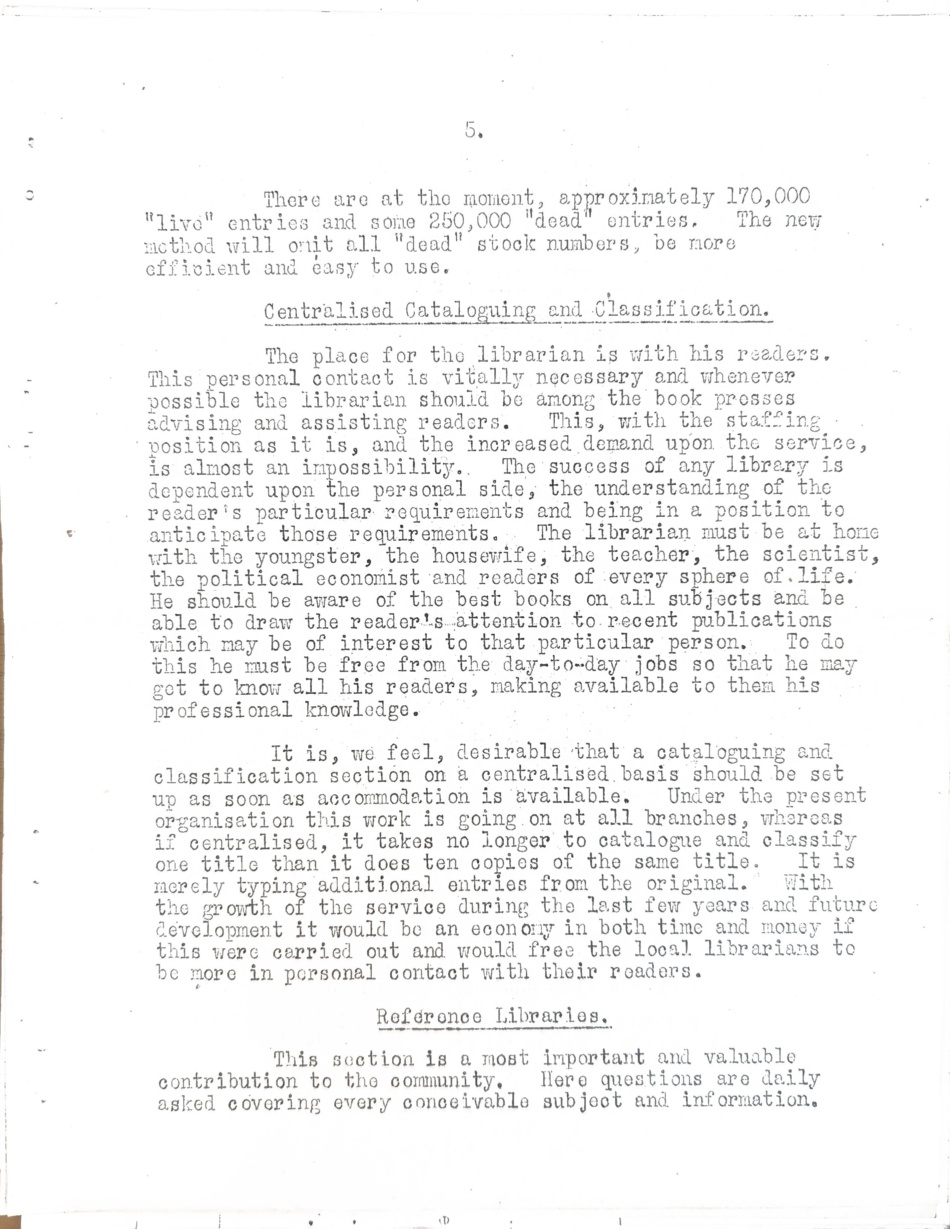
This was certainly true for Deborah who worked as a library assistant at Canning Town Old Library:
So as a library assistant in those days, you pretty much did everything…But mostly, it was about the people. So it was really about serving customers, and you'd have all of your regular customers that would come in, and a lot of the time for a chat…I mean, for me, that was always the really important thing is, you know, you're friendly, welcoming and open with people, then they're going to see it as a place for them…the fact is you don't need to consider yourself an avid reader…sometimes it's just about finding the right medium, the right book…so there's something here for absolutely everyone.
This was something she had in common with Kate, who took Deborah under her wing in her very first library job at the Boleyn when she was 16 years old. Here, Deborah remembers Kate:
They would have one particular gentleman who'd come in every Saturday morning and take the maximum he could of Westerns. A lot of Mills & Boons. (Kate) was an anarchist librarian, she probably baulked at having to put them out, but you were catering for the people, and we'd have one particular woman, Mrs V, and she'd come in every Saturday with her trolley, and take out her Mills & Boons, but because she'd read so many, she used to put her initials in there on the inside of the thing, so she knew which ones she'd read…(Kate) was a librarian who really, really knew her craft…knew that she was catering for an East End population, and if they wanted Mills and Boons and Westerns, she was going to give them Mills & Boons and Westerns.
Jo always felt at home at the old library:
So the old Library, yes, it was so homely, so warm, so friendly…It was like going home. You know, you knew the staff in there.
William remembers how Kathy Gribble ran the library:
One thing where Kathy Gribble was, I think, slightly different from some librarians at the time, was she did not demand absolute silence in either the junior or the senior libraries. She wanted her staff to talk to people, to be helpful to people. And you didn't want to just have them just whispering at the reception desk when books were handed in or stamped out. So it was a nice place to work.

First Jobs and Life Lessons

William and Deborah both spoke about the formative experiences of working at Newham libraries as teenagers.
William worked at Canning Town Old Library in the school summer holidays of 1980 when he was 17. He applied for the job to pay for a trip to Kaiserslauten in Germany with the Newham Academy of Music, where he played the tuba.
So I wrote the application and was invited in for an interview…and otherwise I'd have been sitting around doing nothing watching cricket probably…
(About the music trip) So it was nice to be able to say, actually, Mum you don’t need to, I’ve paid for it, this job will pay for it.
Six weeks…Did they change my life? They certainly impacted my life. They enabled me to go on that music trip, which I might or might not have gone on. And I've been using various skills learned, sometimes have grown with me, subtle messages that I probably don't even think about, that all stem from six weeks in Canning Town Library.
Deborah’s first introduction to library work was as a Saturday assistant at the old Boleyn Library when she was 16 in 1983. Recalling how happy she was then, she came back to library work years later, at Canning Town Old Library.
I applied to the library and got this interview at Boleyn Library. We were all women that worked there and I remember being shocked and amazed and, you know, when I, on my first Saturday I worked there and Kate the librarian kind of, you know, ran in with her odd coloured socks and her CND badges and her wild hair, eating half a piece of cold toast and flapping her arms around wildly about the latest book she was reading.
I was like, wow, what is this place? I absolutely loved it, and yeah, we were a bunch of women. It was all women who worked there and we became so very close. It was great. I mean, I was only young, but they really took me under their wing.
Quizzes and Costumes

William, who did a six-week summer job at Canning Town Old Library, remembers some of the games with the children there, which he has taken with him into his work in education:
We did a mini version of Call My Bluff, which didn't work so well, but some of the older kids enjoyed it. Then we had the usual things, weekly quizzes, weekly spelling tests, and a joke contest. I can't remember what the winning one was, but I dare say it wasn't funny at all. In my current school…you came into my classroom, you told me a joke, and if I laughed, you won the prize…that game I thought of because of Canning Town Library.
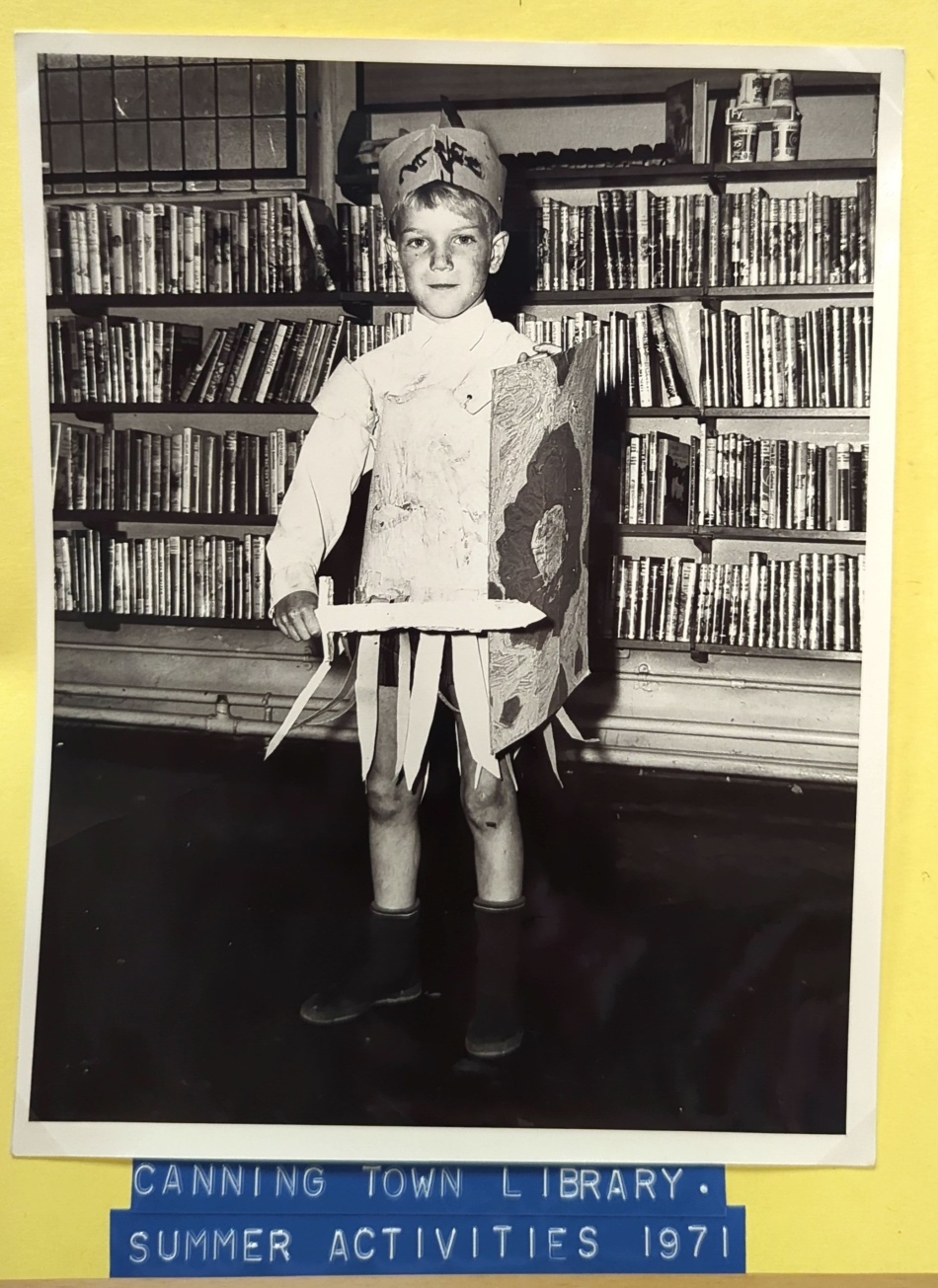
Mark vividly remembers a fancy dress competition at Canning Town Library when he was 7 years old in 1981. He emphasises the effort made by his mum to make the costume, and his sense of injustice at not winning.
I was dressed up as the Artful Dodger from Oliver Twist. I remember my mum putting mascara on my feet...So the big part of the Artful Dodger's outfit was a top hat. He was known for that. I probably had a pair of old school trousers on because we all had to wear sort of Farrah trousers for school. So they would have been cut up a bit. Probably a pair that was too small for me or something. And she must have got me a little jacket from somewhere…A lot of effort went into it…Where would you even get a top hat for a kid? God knows, but she got a top hat from somewhere…The mascara on the feet. Looking back, you know, made your feet look like dirt. It was a great idea.
I remember I didn't win…and I was very aggrieved at not winning. I can't remember who won. I remember I was looking forward to it. So I was excited about it. And I remember I enjoyed it while it was going on. It was good fun…And I remember being crestfallen when I didn't win. Gutted.

The Magic of a New Book


Deborah recounted how book selection changed at some point in recent years, from the librarian selecting the books, “so each library had its very unique character, and that depended very much on the librarian”, to a book supplier selecting them for the borough. Regardless of the selection method, the excitement in opening a new box remained.
When we'd come into the old Canning Town Library, we'd get our new boxes of books, and you couldn't wait to dive into them to see what you were going to put out on the shelves and, you know, and how many you were going to bring home.
Joan’s words also encapsulated the awe at getting a new book from the library:
It was 1946, and by the time I got to like books and that, it was basically, you got a book (at) Christmas. So going to the library, it was like, oooh, it was just unbelievable. You know, like, there was rows of books, that you could go in, and you could take out. (When I was a child) I think I must have read all, oh, Enid Blyton, and, well, it was like magic. And I'll tell you something, if you was lucky enough…to get a book out before anyone else had read it, I thought that was heaven! I used to think, oh, I've got a new book!
Reading the Papers, Quietly!
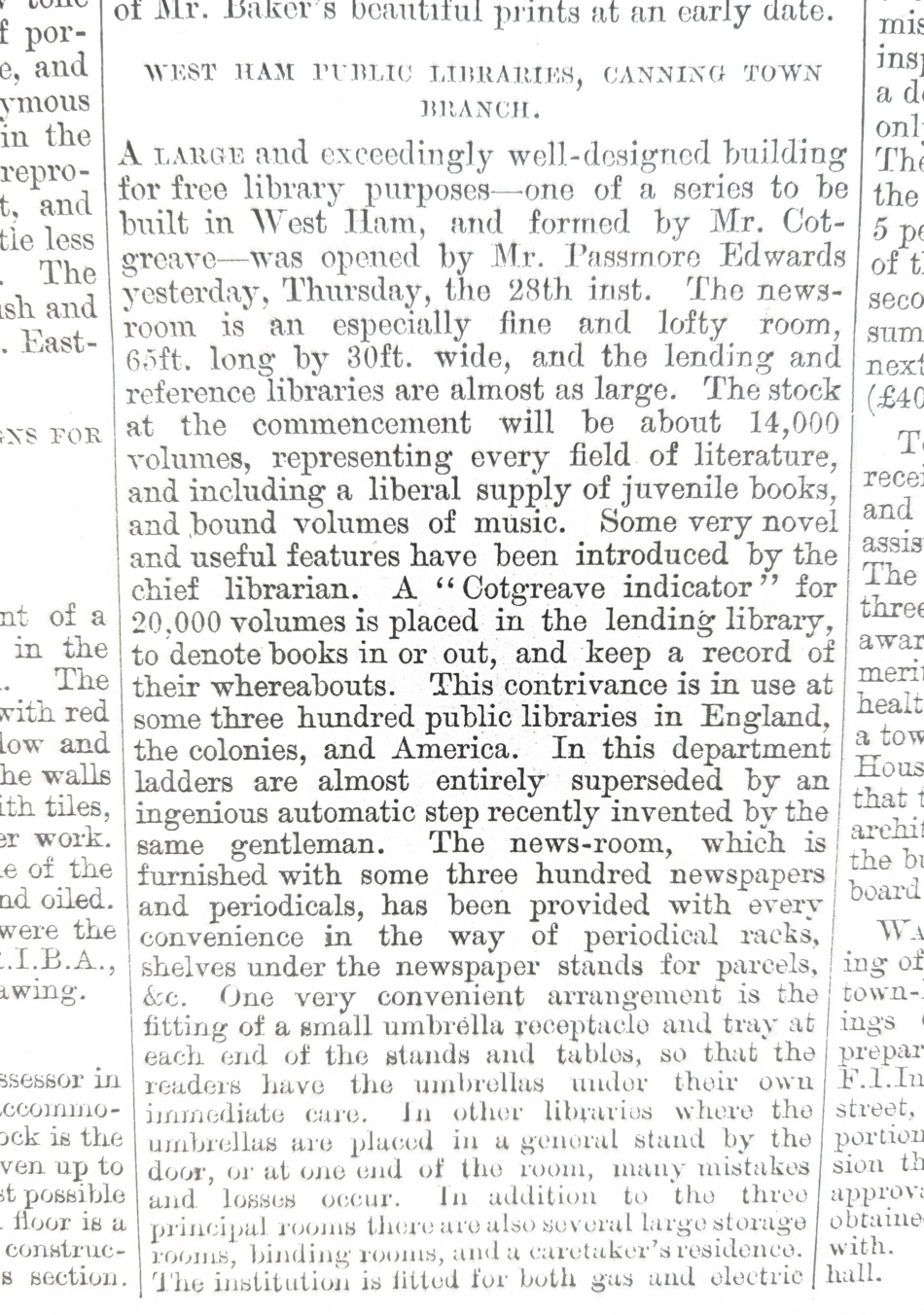
The ‘newsroom’ also made an impression on several of the people I interviewed.
There was an area where they had the daily newspapers, which were usually being read by gentlemen there more than ladies. In fact, I don't remember seeing any ladies ever reading the newspapers…As I say, you weren't allowed to speak in the library. So it was always quite quiet, other than the men turning the pages of the newspapers.
-They had newspapers and you weren't really allowed up there as a kid, and it was absolute silence…The papers were kept on massive long sticks…nice big comfortable chairs…I remember the old geezers up at the library…they were all smartly dressed, they always went out in a collar and tie, which was impressive really…Reading their papers, they'd get the right hump if you made any noise, they did, the old fellas, they weren't having it.
When you came into the library, you'd come into the furthest back of the library that I remember. That was the reading room. If you wanted to read a newspaper, that's where you'd go. As a child, it probably looked a bit like, you know when you watch those old black and white movies and you've got those people with their newspapers... I don't ever remember going in there because it looked like a serious space.
You could go there for papers…And I'll tell you now, chance would be a fine thing to get hold of the paper, because the men that used to sit in Canning Town Library, they hogged them papers. You'd be lucky to get a chance to read one of them.
How to Behave in the Library
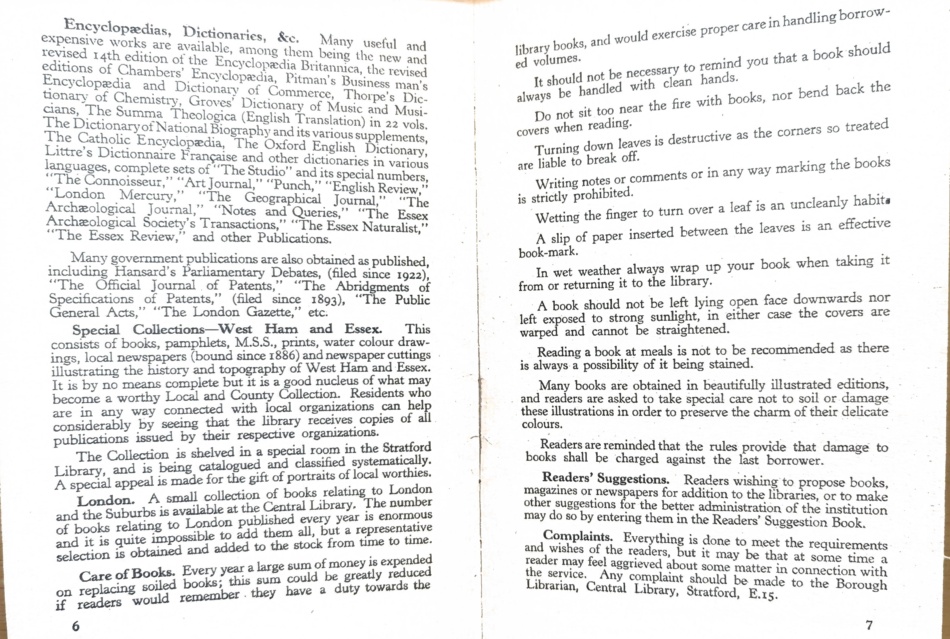
Handbooks on how to use the library, from 1936 and 1938. This was a small stapled booklet, with leather effect front and back cover, which included details of all of the libraries in Newham. It wasn’t necessary to remind Beverley of these rules, over 30 years later:
I'm very particular about books. Books should be treasured and books should be looked after. I wouldn't be one to write in a book. I don't even like turning corners down on books. I prefer to use a bookmarker. I'm very careful with the books that I have, and I would return them on time.

There was a sense amongst a few people that I interviewed that the Canning Town Old Library elicited respect,that this was a remarkable building and something to be preserved. This extended to more than the care of the books, as remembered by Mark:
I wouldn't have been aware of this at the time, but I'm sure the quality of the architecture would have…(had) an impact on people…I definitely had a sense, this is an important space…this community facility was born out of us going to work and building this…almost like a sense of ownership…and I think that probably explained the expectations or the objections of older people to us messing about in there. It was almost like an extension of their house.
The Library as a Haven of Information


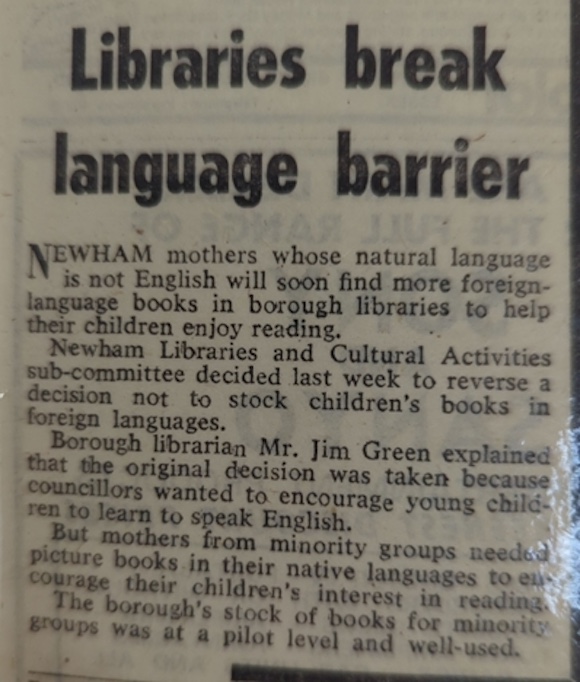
This idea of the library as a place for information sharing is a theme which came out in a few of the interviews. The resources and help available ranged from signposting to community spaces; advice on things like housing; digital skills lessons; cycling proficiency; promotion of local events and interest groups; and updates about when the boats would be docking.
If you had people that went away to sea, they would know when the boats would be docking. So that was another lot of information. People like, say, my brother-in-law, that went to sea…their wives or mums or, you know, they would know when the boats would be docking. So the library would give information when the boats would dock, or were being docked.
This idea of the library as a community hub, a place for more than just books, further developed in the 2000s:
So a lot of the staff in the local service centres came over and worked in libraries, and the idea being that we were much more of a central hub for council enquiries. So people would come in and ask…for information about housing or their rents, and we had a direct telephone that we could put them on. So we became more skilled in answering general council enquiries as well as, you know, library enquiries. It was a real community hub there. I think the library for people was a place of information, and it was a warm and safe haven.
Extending the Library’s Reach


The Bustle Outside the Library
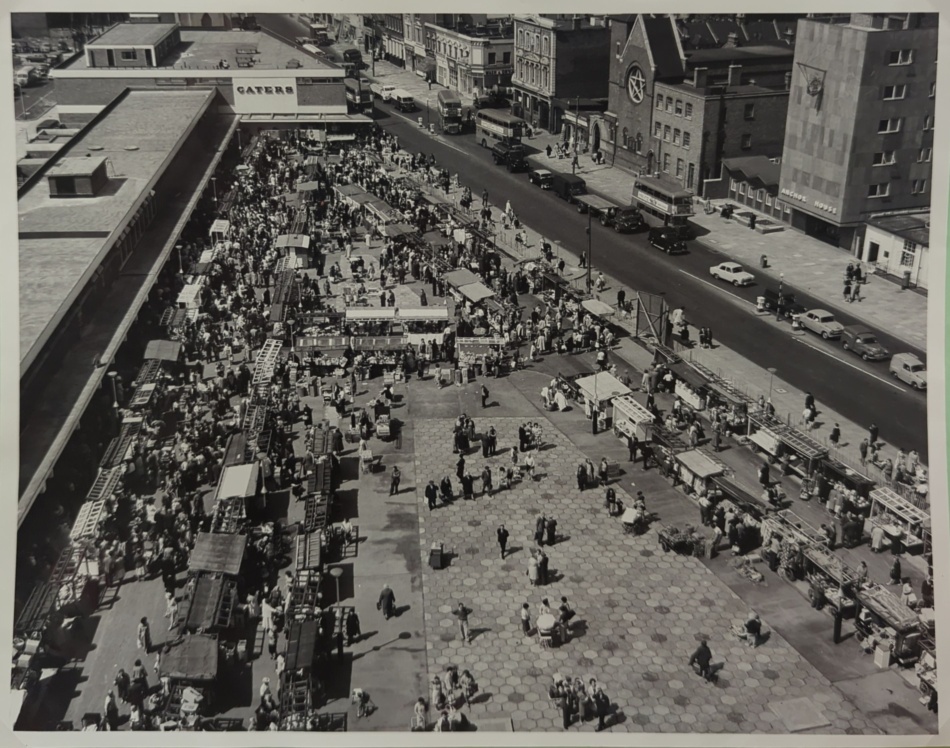
Kathy Holding remembers shopping at Rathbone Market with her mother:
I can see it now, the stalls, and the people on them, and the people shouting out. There used to be a stall that was piled with stockings, didn't have tights then, and you have to stand there, and I think they were sixpence a pair, but you had to pair them up, so you'd find one good one, and then you had to try and find another one that matched it.
And there was the pie mash shop that we would go into, Mrs. Olley's, there were the butchers along there shouting out, we used to call them Bacon Bill's. You could buy loose biscuits, and they'd just put their hands in and weigh you up a pound of biscuits. You'd be told not to eat them there, but we did, and you could buy broken, they'd have a tin that was full of broken biscuits.
There was the stall that you bought the cake from, and the one where you went and got your vegetables from, and oh, the fish stall, where they'd have the live eels or whatever, scurrying round. I remember my husband saying, his nan used to say, go and get an eel down Rathbone and bring it back alive, make sure it's a live one, which was always quite difficult.


Jo, who was born in the 1950s, recalled the varied and much-loved businesses that were on the Barking Road but have since closed down:
We had the high street, where we had a Boots, you know. We had Blooms, we had some wonderful shops. We had every shop, except for all these chicken shops. We didn't have them. And we don't want them…The market was brilliant. And when we had the Good Friday Market, which would have been outside of this place now, it throbbed. It throbbed with proper stalls, proper people, and they came from all over to go there.
But, you know, these were stalls, family stalls, that went on and on forever. We always used to go for the clothes, the mother and daughter stall. They always had the latest. You know, you'd get anything there. They had a drapery stall, where you'd buy your curtains. And I don't just mean nets. I mean proper nice heavy curtains that they'd make. And, you know, we had Thakes, the fishmongers. Oh, we had the Nickels, the egg stall. We just had everything, you know. And the shops. We did have a Wade's, a Pollards. And, of course, Percy Ingles, the bakers. Best bakers in the world. Shame he ever shut down. But they were the local ones, and they were all local companies. You know, they weren't big multinationals or anything like that.
Additional record details
- Contributor: Aimee Pickering
- Type: PhotographsWriting
Heritage newsletter
We would like to send you monthly emails spotlighting heritage content in Newham, as well as updates and opportunities to be involved in next year's festival. Be the first to hear about new projects, funding opportunities and ways to be involved.