Title: Oral History.docx
Interviewee/s: Asif Shakoor
Interview Date: 10th May, 2022
Interviewer: Syed Muaaz Asim
Transcriber note:
Q: Today is the 10th of May 2022. My name is Syed Muaaz Asim and we are doing this interview for the Olympics and the Muslims project for the Newham Heritage month. We are in Masjid Ibrahim, UK Masjid Ibrahim. And I am joined by Asif Shakoor, which is spelt A-s-i-f S-h-a-k-o-o-r, if I’m right. And could you just tell us your age and where you were born.
A: Thanks. I am Asif Shakoor and I was born in Manor Park in Newham and I’m thirty-nine years old.
Q: Thank you very much. So the aim of our project is to basically highlight the involvement of Muslims in the Olympics, anything from participation to volunteering. And we’re very lucky that today with us, Asif was a volunteer during the event. So if you could, from the start, explain how you got involved with the volunteer – as being a volunteer, because that’s a very special thing in my opinion for one of the biggest events in the world.
A: That’s right. It’s a good question. It was actually over a decade ago when I first began – probably more than a decade. I was actually just keen on being involved in Newham as a volunteer, although I’d been working for a large number of organisations including the Islamic Newham Alliance Islamic Association Chamber Counsellor, Dr. Sophie Kiley,. And I began volunteering – just out of passion and I gradually heard about the Olympic games taking place so I was working semi-part time, but eventually I got excited when I heard of the Olympic games. And I got more involved in 2012 when I actually attended workshops as part of the training process to volunteer with the Olympic games. We received certificates certifying that we reached the standard required to be a volunteer.
Q: So this training that you mentioned, what did the training include? Was it first aid, stuff like that or what did it include?
A: It included training such as it was a workshop where how to greet and how to welcome people to the games and it also included first aid, basic first aid that is. And meet and greet. Training along these lines of how to hand out leaflets, how to welcome people to Newham. How to approach them with a smile, like with positivity.
Q: So how was the event from a volunteer’s perspective? Obviously, there was us in the crowd, sitting at home or in the crowd, watching the sports. How was it from a volunteer’s perspective, what did you have to do?
A: From a volunteer’s perspective it was quite actually exciting and it was different because, I guess, most of the spectators would come and enjoy the games whereas for us, it was different, it was more like welcoming people, directing them, showing them round. So it was quite a different experience but it was also exciting because being part of such a high profile event in Newham and being from a Muslim background and I was quite young then, I was quite into sports as well so it was quite exciting.
Q: So what were the main duties a volunteer had to do at the Olympics?
A: Oh for us as Active Newham – volunteers Active Newham, we were given like – we had – the council – Newham council had set up actually terminals they looked like, telephone boxes but it was very pink, so they looked like red telephone boxes that you see in central London. They were not actually telephone boxes; they were actually information boxes. So we had all of our leaflets, brochures and loads of information stored in some of those boxes and they were daily filled up, every day. And we had to literally get leaflets from there and maps for example, hand maps out to spectators that were visiting the games, or visiting Newham. Just – not even attending the games, just visiting Newham to see the excitement. So it was giving out leaflets, guiding people to like local pubs or the local shopping centre or even to the Olympic games, Olympic Park. If they want to get to Velodrome, we’ll direct them, if they want to get to Westfields, Stratford shopping centre, we’re directing them. Certain exits and entrances were shut, so no access to public.
Q: Was it a large number of volunteers you were working with?
A: In my opinion I think it was probably the largest I’ve seen, being a volunteer for Active Newham, it was the largest I’ve seen. Because I remember for the training sessions, it was like literally – there was blocks of training sessions, they were literally all booked for six to seven months ahead of the games. That was a long process to hold so many workshops training the masses up and, you know, it went over six months. And I remember so many people training up. You know everyone volunteers eventually, that’s another thing, just some people dropped out, some people had other commitments, some people may have volunteered on a short part-time basis, some people gave more time than others.
Q: So was the group – it’s a very big number, as you were saying, was it a diverse group, or was there any one ethnicity, you’d say, was prominent, stood out?
A: That’s a really good question again. I think it was a really diverse group, you had people of all nationalities in the group. I remember Muslims, Sikhs, Hindus as well, Christians, white, black, non-white. So it was a quite diverse group and I think that it was so important that because there was a large number of Muslims in the group as well. And I was quite – I found that interesting because we’ve got a borough which has a high population of Muslims. In Newham we celebrate our diversity so it’s a really good thing to see young Muslims participating and young faces.
Q: So along those lines, were you satisfied with the Muslim participation in the event, or do you think us, as a community, could have done a bit more?
A: I definitely think that there’s always scope for improvement and so I think that we could have done more as a community. I think considering how many Mosques we have in Newham, it’s something like over fifty Mosques, I think there could have been more of a participation, higher turnout from the Muslim community. But having said that, I think that I’m satisfied with the amounts that did participate. Although I wish there was more participation Muslim athletes in the games, I know there’s Mo Farah [laughs] who’s an athlete, but I wish there was a bit more. But from – as a volunteer, I think there was a large number and I think considering how many Muslims are resident in Newham, I think there could have been a bit more.
Q: So are you still in touch with some people you volunteered with, did you make any friends, are you still in touch with them?
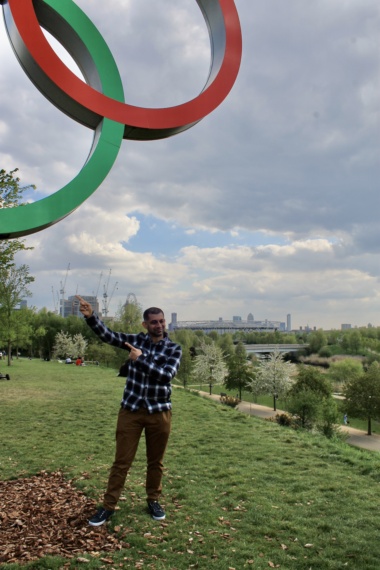
A: I definitely am – it’s a good question. I’m in touch with them and I was recently at a photo shoot at the Olympic Park, as part of the Newham Heritage – the Olympic games celebration. And in that photo shoot there was a lady that I met after a long time who was actually a supervisor as a volunteer for the volunteers. She was a supervisor, which I met. Again I’m still in touch with a lot of people that were volunteers. I instantly can think of my brother [laughs], he was also a volunteer, his name’s Yasar Shakoor and he was in Sainsbury’s, locally and he volunteered as well, he still does, he’s quite active, he even does a triathlon. So I’m still in touch with quite a few people, for example, my brother’s my first point but I’m in touch with quite a few people, yeah.
Q: Was there any incident that stood out for you from the event?
A: Do you mean what I liked?
Q: It could be anything.
A: Yeah, there definitely was. I definitely – I like – the thing I liked about the Olympic games the most was as a volunteer I was privileged to see the rehearsals of the opening ceremony and now that I could not have imagined. Because the tickets they’re sold out for the actual ceremony, the opening ceremony was sold out really randomly. So I didn’t actually expect to be able to see a rehearsal ceremony and that really stood out because when I actually go to the rehearsal ceremony it was actually – and it was actually – I was actually quite surprised that the entire stadium was literally full, just for a rehearsal. And the droves of people that were actually coming in from outside London and from other parts of London to see the rehearsal was actually quite huge. And to see the stadium full just for a rehearsal and to see the actual rehearsal ceremony and to see, you know, huge pillars popping up from under the ground, fireworks and all sorts of things. It was just amazing. It seemed like really one of the greatest shows on earth. But obviously, not in numbers ‘cos, obviously, the Hajj is one of the greatest – greatest turnouts on earth. So it was actually amazing, the only difference was that in the rehearsal ceremony the prime minister, the Queen or senior members of the Royal family, were not present. But everything else was literally what you had seen in the actual ceremony. And apart from the fireworks I guess.
Q: Did you get a chance to meet, as you mentioned, high profile people, so like you mentioned the prime minister, some of the Royalties, or celebrities, did you get a chance?
A: It’s a really good question, I wish I had met some more personalities, athletes. But actually what was really a privilege was that we actually had a chance – a lot – ‘cos a lot of the athletes was actually loitering around Westfield Shopping Centre, you know, coffee, tea or chit-chats. Another thing, you could see them making photos of members of the public, so you got a chance to meet a few. But because we was volunteering, it was kind of a bit difficult to ask for a photo shoot. But I don’t know if some volunteers done it, but I saw a lot of people making photos of athletes and athletes in their clothes, speaking to members of the public as spectators.
[0:10:40]
Q: How would you say volunteers were treated by management? Would you say you were treated in a fair way, in a good way, or was there any complaints in that regard?
A: In that regard, I don’t think there was any complaints. I was actually quite satisfied and happy. Um, I think it was great the way they treated us because they actually looked after us and the leaflets were – daily maps were what was going out really fast, everyone’s asking for maps of the Olympic Park and that was going out fast. Um, and daily our information boxes was stocked up with leaflets, every day literally, so that – ‘cos so much had been distributed, they literally stocked up every day. We was even taken care of – we was given t-shirts, a bottle, which I kept as memorabilia, we was given a lot, I can’t remember – a t-shirt, bottle, caps as well, bags as well. And we was given meals as well, so I cannot say we were not taken care of, we was given meals, drinks ‘cos it was quite hot.
Q: Was there anything that was done for you as a token of appreciation after the event?
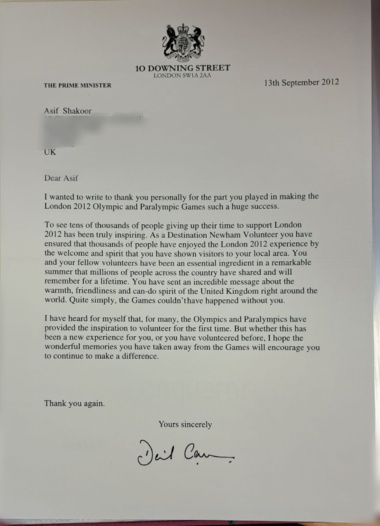
A: Um, well that is a really great question because I actually in the group – one of the greatest things I cherish after the Olympic games was actually received a letter of commendation from the prime minister, the former prime minister, David Cameron, and that was dated the 13th of September 2012, thanking us for our participation as volunteers in the Olympic games. Shall I read that out? I’ll just read the first sentence out, Muaaz, it mentions there … “I wanted to write to thank you personally for the part you played in making the London 2012 Olympic and Paralympic games, such a huge success …” I won’t read out the letter, it’s quite long.
Q: So was there any negatives? I’ve heard from you that there was a lot of positives, was there anything negative during the event?
A: Er, I think there was nothing negative. I think it’s so positive because being allowed to see the rehearsal as well, you couldn’t ask for much more and it’s so much – it’s so exciting meeting people from different backgrounds, people have travelled from all like, Scotland as well. Some people had booked hotels and stayed there four nights, so there was like, you know, three nights, so there’s nothing negative. But I just feel I wish there was more of a – a greater involvement of the local Muslim community. And I think that’s got to come from the community itself and I know like what you, Muaaz, and Ibrahim Mosque is doing, to highlight the Muslim role and the Muslim participation in the Olympic games because it’s so important because we was part of that legacy too and it’s important that the legacy’s kept going and passed to our next generations.
Q: Thank you very much. During the Olympics there was another very important event going on for us Muslims. It was also the month for Ramadan. So how did you manage to cope with Ramadan because it gets very busy, it’s a very packed schedule, so how did you manage to balance Ramadan and the volunteering event?
A: It’s a great question I know ‘cos during Ramadan the days are long and it can be quite hot as well. Um, but how we balanced that is that we was actually allowed long breaks, or breaks that we could request for it – to take extended breaks to keep us going. So that’s how we balanced it out and often when people need to pray they provided facilities at Westfields, there was a prayer room set up actually. ‘Cos there’s two prayer rooms now, there’s a new one actually now, set up, a much larger one at the former Covid vaccination – it actually closed down so there’s a new prayer room set up – there was a much larger prayer room. But there was actually one on the third floor, just by Aspers Casino, just below that actually. And that was actually set up for the purpose of the Olympic games and that was set up in Aspers, to cater for the needs of the Muslims that were participating in the games, athletes, as well as members of the public. So we had access to a prayer room as well and that was a multi – it was actually called a multi faith prayer room but it was mainly used by Muslims.
Q: So these extra or prolonged breaks that you mentioned, was this only for volunteers who were fasting or was this for everyone who maybe just wasn’t feeling well that day?
A: [Laughs] Just like the multi faith prayer room was for everyone and it includes diversity. So it includes diversity but it was open to everyone, but it was predominantly the Muslim community that used it. Similarly the breaks were open to other communities from the diverse background but, I guess, because it was the month of fasting, Muslims would need to use it more, or made use of it more.
Q: So was there anything you would change in the Olympics, or anything around it that you would change?
A: Er, there’s nothing I would change but I would like to see greater Muslim participation, sporting activities. It’s not about just being – the religion being confined to a Mosque, it’s more – also activities, sports. And it’s nice to see people keeping fit and doing activities to keep fit too. So I like to – and I like to see the legacy carried on like UK Mosque is doing, Ibrahim Mosque is doing, sorry. I like to see the legacy carried on and I like to – I like greater participation and the local Muslim community to come forward, give interviews, let us know their views, what they think how the games were. To pass that legacy on to the next generation and keep it going.
Q: How was the public’s reaction, obviously the event – it’s a large amount of people coming to the event, how was the public generally, was it easy to interact with them, or as we normally get with a few angry customers?
A: [Laughs] No there were a few people who were frustrated like especially I met an elderly couple who was quite frustrated because the Olympic Park is quite a large space, it’s quite spacious and it’s – and if you’re not familiar with it and it’s newly built, it could be quite tiring walking a long distance from one end to the other. And I had an elderly couple who was actually quite frustrated, they couldn’t find certain locations in the Park and then eventually they were upset again that they wanted to go for a drink after one of the games. And they couldn’t find a local pub, so I had to direct them to a local pub and as a Muslim I felt it was just the right thing that I do direct them to a local pub.
Q: I’m just thinking if we’ve covered everything here. Is there anything that you’d like to add?
Q: Is there anything that you’d like to add? Anything that I’ve missed?
A: No, thank you, Muaaz, I really enjoyed that and thank you for giving me the opportunity to speak, air my views across to you.
Q: Thank you very much for joining us, it was lovely having you here. And we’ll leave this here.
[END OF RECORDING – 00:18:04]