The Artful Dodger of Barking Road
About this record
An oral history interview with Mark Lynch-Brown.
I remember my mum putting mascara on my feet… made your feet look like dirt. It was a great idea.
We'd go in and creep upstairs, try not to be seen through the windows and the door of the kids' library and try and creep up there just for a laugh. I remember getting shouted at, and running out and daring each other to do it. So for me, the library was more about something to do.
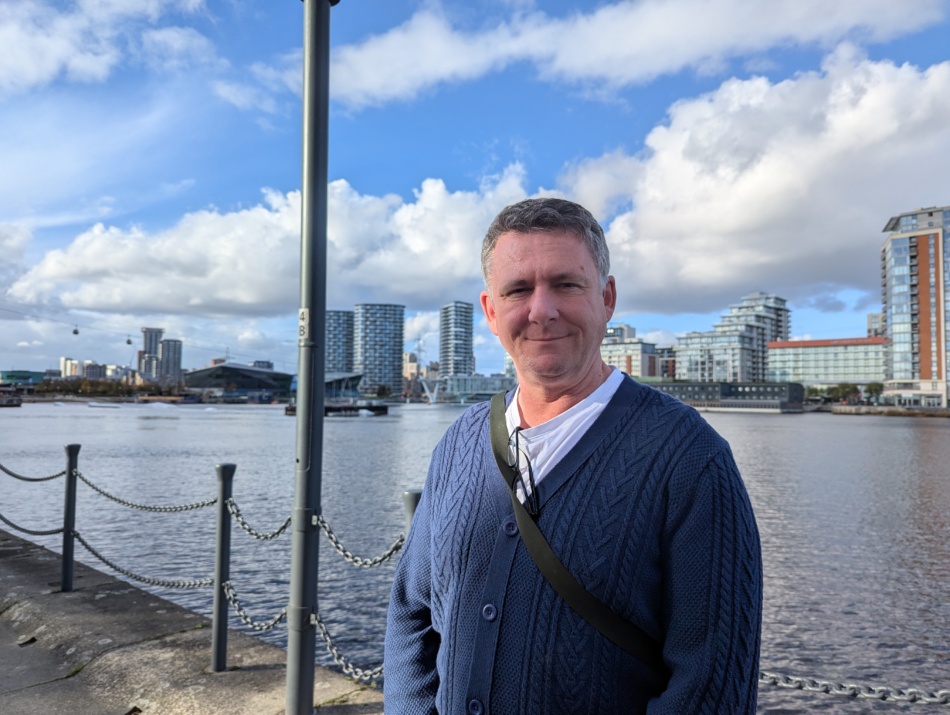
My older brother Mark was born in 1974 in Forest Gate Maternity Hospital and grew up in Canning Town. We both went to St Helen’s Primary School. Mark was the first person to put himself forward to be interviewed by me for the project, and the last person I got round to interviewing. We spoke at my home in Royal Victoria Dock, on 1st November 2025. From the window of my flat, we could see the Tate & Lyle factory where our mum used to work. Mark and I both grew up going to Canning Town library, albeit about a decade and a half apart, and our memories differ a bit. Mark’s memories are a lot more mischievous. Mine are a lot more studious.
In the interview, Mark reflects on his childhood experiences at the Canning Town Old Library, mainly centred around the six-week summer holiday activities, but also recalls other local activities available to him and his friends in Canning Town during the 1970s-80s, like skiing at Beckton ski slope and watersports at the docks. When Mark was little our mum was a childminder, and encouraged Mark, our other brother Adam, and their friends who she was minding to visit the library. For Mark, the library was “something to do” – be it daring friends to not get caught in the silent adults-only reference library, or participating in summer club activities like building things and writing stories. Later it was reading the newspapers as a young adult when he wasn’t working. Motivated by competition, Mark shares memories of school reading challenges, and a fancy dress competition where he went as the Artful Dodger, thanks to the care, resourcefulness and imagination of our mum.
Beyond the humour and mischief, Mark also commented on the library’s role as a hub at the heart of the community and a place for families and older people to enjoy. Mark reflected that looking back, something he would have had some awareness of almost subconsciously was how important the library was, and how it was a place to be respected. He considers the part architecture plays in forming this impression, and the higher quality generally of civic buildings compared to today – the library being a beautiful, old building, an oak wooden staircase with a huge bannister, and heavy, swinging doors with brass metal handles. He also reflects on the sense of ownership and belonging that the library represented for older generations, which was illustrative of community facilities being born out of them going to work – “it was almost like an extension of their house”.
It was like there was a much closer link between community facilities and the fact that…this community facility was born out of us going to work and building this…it was almost like an extension of their house.
Additional record details
- Contributor: Aimee Pickering
- Type: InterviewPhotographsWriting
Heritage newsletter
We would like to send you monthly emails spotlighting heritage content in Newham, as well as updates and opportunities to be involved in next year's festival. Be the first to hear about new projects, funding opportunities and ways to be involved.